
Finding the human edge in an AI world
Having a competitive edge means having something others don’t. But in an AI world where fast intelligence is suddenly available to everyone, how do you stay ahead to stay on top?
In the land of the dumb, the person with the brain should be king. But what happens when everyone suddenly has access to an intelligence that in certain respects is more powerful than any human mind? Who’s the top boss then? Futurists, innovation experts and technology entrepreneurs are wrestling with this question today, as they try to find ways to build a durable competitive advantage in a world of thinking machines. Worse still, a world of thinking machines could be an existential threat to some businesses. Some analysts are saying that AI is a double-edged sword and that for many established companies, instead of boosting corporate revenues, AI might actually destroy them. Software firms being the most obvious example.
If he were just starting out, Sean Blanchfield, who is currently CEO of Jentic, an agentic AI startup, says he would stay out of pure software plays and look instead at “defensible advantages based in the physical world and resting on human relationships, not just data, information and electrons.” Scott Anthony, clinical professor of business administration at the Tuck School of Business at Dartmouth College, is also bullish on the real. Although AI is changing many processes, some fundamental things will continue to apply: “People will still want a cool refreshing beverage and they will still want financial services they can trust,” he says.

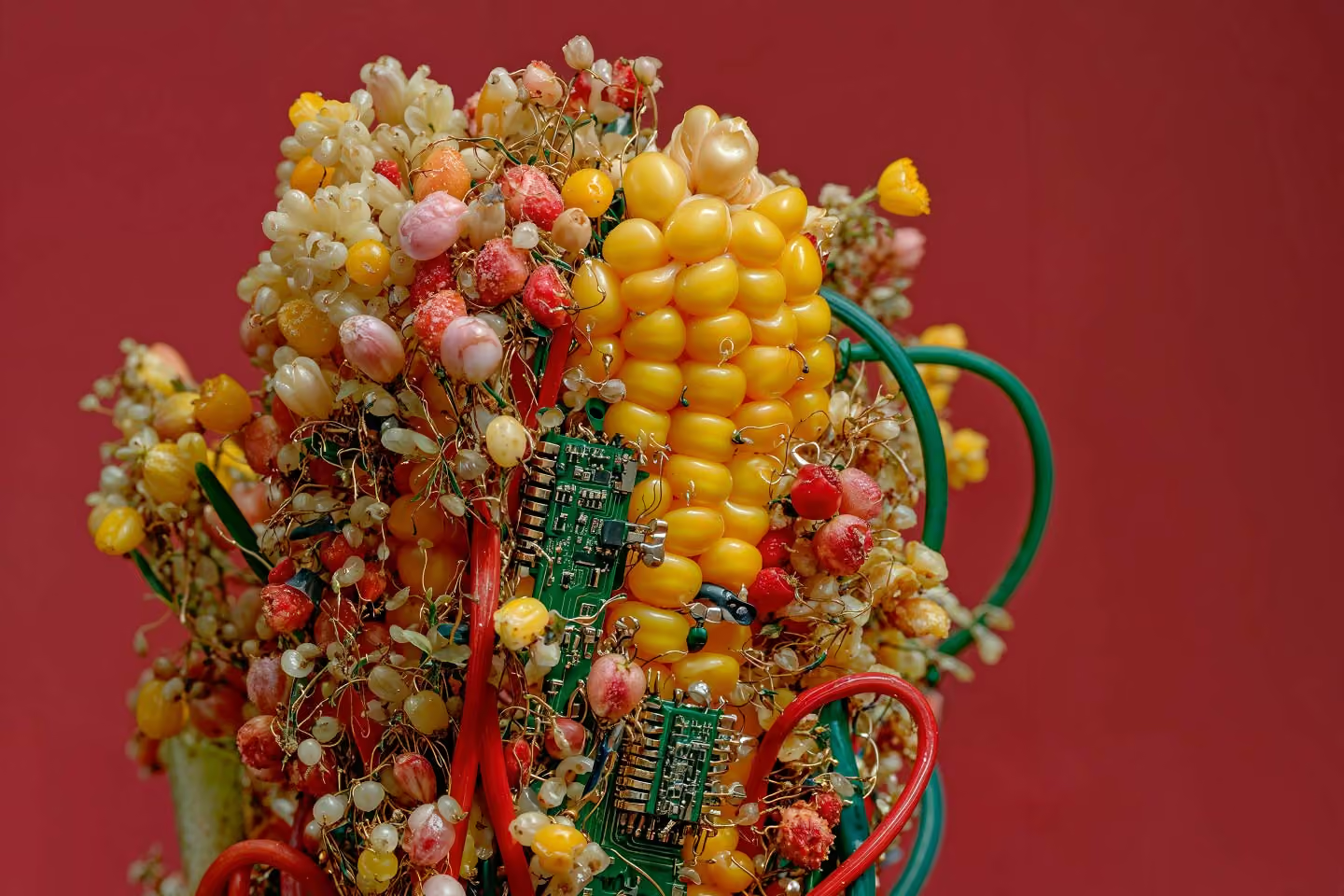
Nature and machine, fused
Manar Aboushawaly is an Egyptian artist and graphic designer based in Berlin. As an AI enthusiast, she leverages the technology to push the boundaries of creativity, combining analog with digital techniques.
Others argue that it’s not just human appetites that retain value. Eric Fellhauer, chairman of the shareholders’ committee and the supervisory board at SMS group, argues that people are underestimating how much value is still locked in crania. He doesn’t share the faith many businesspeople have in the transformative power of AI. “I’m taking that with a pinch of salt because in companies like the one I’m chairing, most of the knowledge is in the heads of the people working now,” says Fellhauer, who is also professor of practice in strategic finance at Frankfurt School of Finance & Management, and former chairman of the German branch of the Lazard investment bank. He has found, for example, that AI is capable of writing deep-dive reports recommending deals that sound persuasive at first glance but make mistakes that someone who knows the target companies’ industry would spot immediately.
Sinan Aral, who is the David Austin professor of management, marketing, IT and data science at MIT Sloan School of Management and the director of the MIT Initiative on the Digital Economy (IDE), believes that the nature of competitive advantage in the AI era ultimately won’t be all that different from what it has always been. “We have seen this movie before,” Aral says. Typically, competitive advantage has stemmed not from the new technology that affected everybody, but from how users adapted it to their situation. The AI revolution will be like those prior tech revolutions, Aral says, in that the technology will be a commodity whose competitive advantage accrues to those who best adapt its usage to their needs.
At the same time, Aral does see a new kind of advantage emerging. In his forthcoming book expected in 2027, Personal Intelligence: The Art and Science of Human-AI Collaboration, Aral will make the case that systems tailored to individual minds will constitute a new field of competition. “As raw intelligence becomes a commodity, the way we fit this intelligence to each human like a glove will become the space for differentiation and competitive advantage,” he argues.

This isn’t entirely speculation. Some studies by Aral and his team have found that personalization of the AI interface has a huge impact on worker productivity. For example, in one of his studies, AI agents designed to exhibit certain personality traits brought out different qualities with human partners. For example, neurotic AI agents – tuned to be relatable with traits of vulnerability and anxiety in their interactions and responses – paired with agreeable humans produced fewer but better advertisements than the average pairing of agreeable AI agents and agreeable humans. Aral’s team also found regional variations: Extroverted AI elicited better quality from Latin American workers, but lowered the quality for East Asian workers.
Another study uncovered the fact that while human-AI teams could produce 50% more ads per worker with higher text quality than the typical human team, all-human teams could produce ads with better image quality. The preliminary results were so exciting, Aral says, his team decided to launch a company that could promote AI personalization, so every employee in every company will have access to low-cost, high-capacity intelligence.
But as with any powerful tool, human foibles can make it dangerous. People are often gullible, Aral says. They respond to what he calls “the veneer of rigor” – signs that something is trustworthy, such as footnotes in a paper, treating the existence of footnotes as a heuristic for accuracy rather than taking the time to drill down to actual proofs. Delivering services that both look and are reliable will be crucial.
Gianpiero Petriglieri, associate professor of organizational behavior at INSEAD, thinks of the changes ahead less in terms of the technology than in terms of the human response to the technology. “Competitive advantage is based usually on the idea of valuable differentiation, and anything that anesthetizes us into a sense of convenience and conformity is, of course, going to reduce our competitive advantage. So for me, the question is, how do we remain awake to what is unique about our work, or unique about our business?” he says.
wired to thrive
As AI adoption accelerates, companies stand to gain the greatest advantage when AI is woven organically into their existing structures.

“The way we fit this intelligence to each human like a glove will become the space for differentiation and competitive advantage.”
AI is the end of the line for the pursuit of efficiency, in Petriglieri’s view. “We want to make money with machines, but then we want to spend our money on things that are made by hand,” he says. Unique, creative offerings therefore will become even more important. One case in point: the transformation of pop music from a business where most artists made most of their money from selling recordings to a business where most of the money is made in live performances. Attendees get something out of these experiences that is very human and almost religious, he says. He remembers going to a Harry Styles concert with his son and hearing him say that this stadium event was a space where people could feel safe and free. “We’ve always longed for that,” Petriglieri says. “I don’t think AI is that space – I don’t think we’re either safe or free there, which means there is still hope for human enterprise.”
In his view, companies will have to start competing like artists – beginning with the same tools and materials, then creating a vision that awakens the consumer’s imagination. This doesn’t mean being unpragmatic, he insists. “It’s not that if you think of yourself as an artist, you don’t want to make money. There are artists out there that are millionaires and really as greedy as they come. It’s just that productivity and profit are not the primary aim. They are a consequence of a focus on what do I want to bring to life in the world,” Petriglieri says.
Many young people are already thinking this way, he adds, a consequence of having been told that they are probably not going to make much money and their working life is going to be insecure. “At that point, you have two options. One is saying, I give up on work having any meaning whatsoever and become really very cynical, or to say, well, but I’m still going to look for work that at least allows me to express myself,” Petriglieri explains. In the end, the ultimate competitive advantage may be something the computer can’t generate: a reason to care. “This question of the meaning of work, which we used to consider in the good old Maslow way as the tip of the pyramid, will become the foundation.”





Stay ahead of the curve!
Sign up for our newsletter and let Think:Act bring you up to speed with what is happening today and guide you on what’s happening next.






.svg)
