

How Lew Frankfort turned Coach into a $5 billion brand with “magic + logic”
Former Coach CEO Lew Frankfort bet on a strategic blend of creative intuition and disciplined, data-driven execution to grow a small, family-owned business into a global brand with multibillion-dollar revenues. In this interview, he shares his winning formula.
Fate can come down to a single cab ride. When New York native Lew Frankfort shared a cab with a Columbia University instructor in the spring of 1979, he first heard about a small leather goods company called Coach Products. The then CEO couldn’t convince any of his children to take over the business, his acquaintance told him, and was looking for a successor. Frankfort did what was in his blood as a curious, ambitious outsider who had worked his way up from modest beginnings in the Bronx: do the homework. “It was possible to have no knowledge about a subject but through a didactic process become conversant, maybe even smart about it,” as he writes in his memoirs. As he dug into the details of an industry that was foreign to him, he discovered a company with 110 people and annual sales of $6 million, waiting to hit the big time.
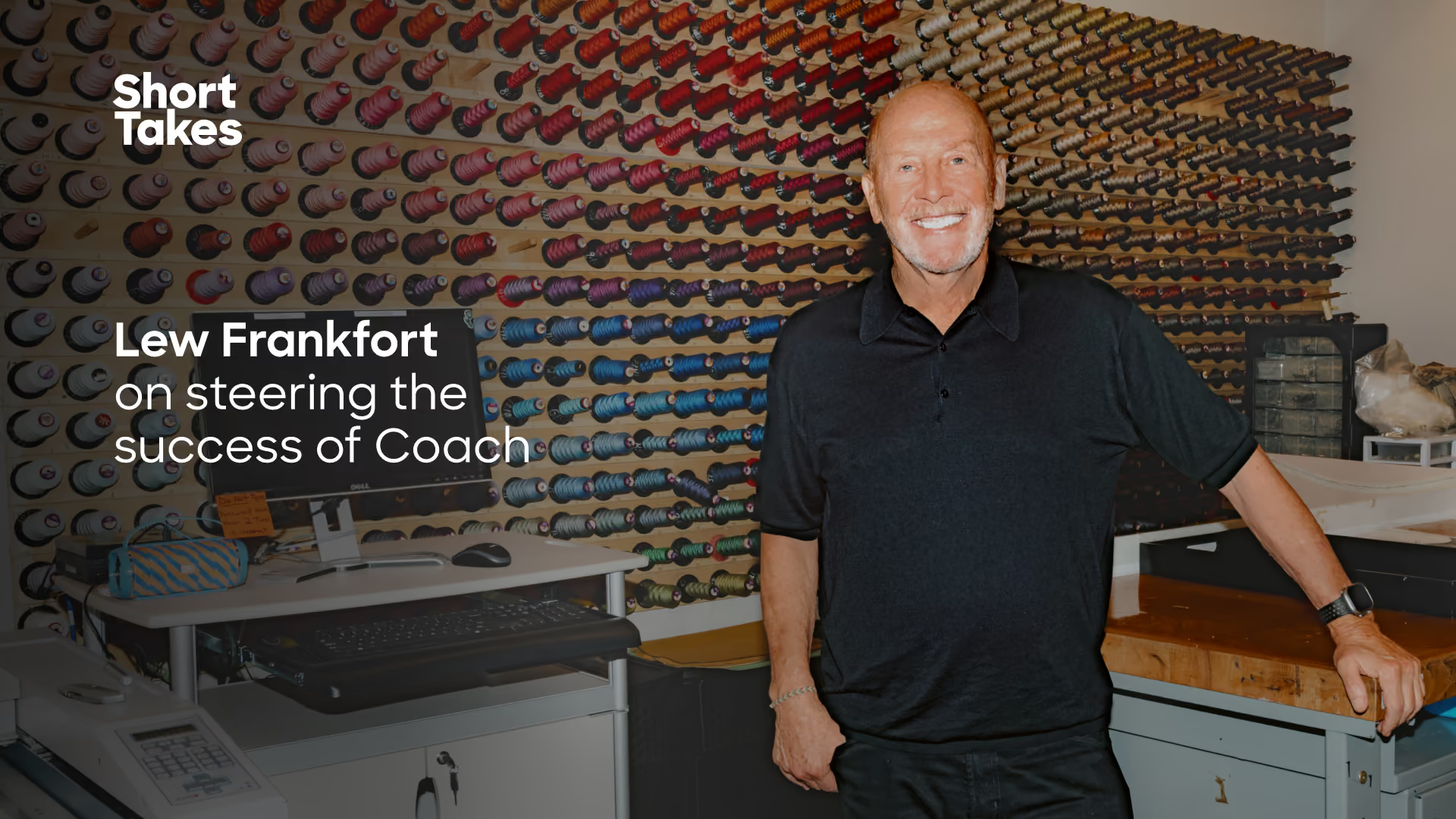
Frankfort took the job and rose to become CEO in 1985. When he stepped down in 2014, Coach had grown into a $5 billion enterprise that is considered the rare US-based luxury brand that can hold its own against famous European incumbents. Now 80, Frankfort still regularly visits Coach’s headquarters on Manhattan’s urban park called The High Line, mingling with former partners and employees who helped him define the affordable luxury niche. His book Bag Man: The Story Behind the Improbable Rise of Coach, he tells Think:Act Magazine, is more than the memoir of a successful businessman but also letting people in on his darker moments. “I wanted to let everyone understand that you can be successful and still lose your mojo and feel depressed.” For this video conversation with Think:Act, Frankfort dialed in from the offices of his investment company Benvolio Group, named after his labradoodle. Dressed in minimalist all black, he talked about his upbringing, his short yet important stint with city government and his approach to sussing out consumer values and trends.
Frankfort took the job and rose to become CEO in 1985. When he stepped down in 2014, Coach had grown into a $5 billion enterprise that is considered the rare US-based luxury brand that can hold its own against famous European incumbents. Now 80, Frankfort still regularly visits Coach’s headquarters on Manhattan’s urban park called The High Line, mingling with former partners and employees who helped him define the affordable luxury niche. His book Bag Man: The Story Behind the Improbable Rise of Coach, he tells Think:Act, is more than the memoir of a successful businessman but also letting people in on his darker moments. “I wanted to let everyone understand that you can be successful and still lose your mojo and feel depressed.” For this video conversation with Think:Act, Frankfort dialed in from the offices of his investment company Benvolio Group, named after his labradoodle. Dressed in minimalist all black, he talked about his upbringing, his short yet important stint with city government and his approach to sussing out consumer values and trends.
Frankfort took the job and rose to become CEO in 1985. When he stepped down in 2014, Coach had grown into a $5 billion enterprise that is considered the rare US-based luxury brand that can hold its own against famous European incumbents. Now 80, Frankfort still regularly visits Coach’s headquarters on Manhattan’s urban park called The High Line, mingling with former partners and employees who helped him define the affordable luxury niche. His book Bag Man: The Story Behind the Improbable Rise of Coach, he tells Think:Act, is more than the memoir of a successful businessman but also letting people in on his darker moments. “I wanted to let everyone understand that you can be successful and still lose your mojo and feel depressed.” For this video conversation with Think:Act, Frankfort dialed in from the offices of his investment company Benvolio Group, named after his labradoodle. Dressed in minimalist all black, he talked about his upbringing, his short yet important stint with city government and his approach to sussing out consumer values and trends.
Lew Frankfort was born in March 1946 in the Bronx. The son of a police officer and a stay-at-home mother, he was the first in the family to attend college and was particularly enthralled by psychology and political science. He later earned an MBA from Columbia Business School. After a brief stint on Wall Street, Frankfort worked for the New York City government for a decade, taking on the thorny issue of reforming financially strapped and mismanaged child services before stumbling upon Coach Products. After stepping down as its CEO in 2014, he launched the venture capital firm Benvolio Group.
Many CEOs highlight their modest upbringings and even their struggles against adversity when they write about their life’s journey. You do the same. How important is that to explain success in later life?
One of my motivations was to give something that would be informative and compelling to Gen Z and Millennials. I do believe my generation, the 1960s generation, faced challenges and opportunities that Gen Z are also facing in that they’re all about authenticity, real relationships, speaking truth to power and not accepting arbitrary authority. Part of my motivation also was to lay out that you can still live the American dream in the United States despite what’s going on in our world. That’s why I write about adversity as a child. I am the son of immigrants and the first who went to college. My father was a cop. I was a late bloomer and I had speech impediments, but I always believed anything was possible in America.
Before you joined Coach, you worked for New York City’s government. What valuable lessons and skills did you acquire during that stint as a public servant?
I think most importantly, I was very client focused, and I felt almost messianic about my responsibility to fix the daycare and Head Start children programs, which were the poster children for scandal and corruption. I wanted to do my very best for families and children within the context of fiscal constraints, eligibility requirements and the like. So when I came to Coach with no background in fashion and no background really in business, I decided that I would learn about the business first through customers.
What did they tell you?
I spent a great deal of time learning about the DNA of the brand, its appeal. It had a very loyal following. In fact, I was told by a shopkeeper whom I interviewed pretending to be a Businessweek reporter doing an article on Coach, that it had a cult following. Then I went to study brands from Europe, which unlike the United States has a history of luxury brands. What I saw was a small French brand at the time, Louis Vuitton, that controlled their destiny. It gave me an opportunity to envision Coach one day as a democratized luxury brand, giving consumers a product that had grit, value, durability.
Against the grain
The former Coach CEO, who still visits the production department of the company regularly, had a vision that set new standards for what attainable luxury could mean.

Your mantra as a manager was “magic + logic.” Can you explain what you mean by that?
You have to really understand what motivates consumers to purchase your brand. You need to understand their values and interests from an anthropological perspective. Being relentlessly curious is also an essential quality to grow a business – using your instincts as well as the information that you develop by speaking with consumers to understand the journey that they are taking. Another quality on the magic side is a greater good mindset, understanding that you are working for an enterprise that’s larger than you, and then being able to subordinate your own views.
On the logic side, it’s about marrying data analytics – what gets measured – with a view of how the world is moving and how you can incorporate that. Collaboration is also important. I spent a great deal of time bringing people together to help them become teams as opposed to working in silos, so that they would be working not at cross purposes, like design and manufacturing often does, but in unity. So there’s logic and magic and there’s magic and logic, and I believe that blend has served Coach extremely well.
A cult following and deep customer loyalty are almost intangible qualities. Coming from the data-driven, analytical approach you just mentioned, how do you reconcile the tension between the two?
Today, there are brand pyramids, and I started to use my own version of brand pyramids 30, 40 years ago. Think of a triangle with three parts, which all add up to brand equity. The lowest level is belief in the company as being trustworthy and reliable. Then come the fundamental equities, which are tangible: durability, quality, value. Above that sit the emotional attributes. So if you build a home, you really want a good foundation – and you also want to create some magic, the storytelling that comes out of understanding what your equities are and what resonates with your target consumers. We represented great value. We also represented hope and aspiration for generations of Americans in our earlier years. We priced our products at a price that was really accessible to 40% of Americans, and we decided in that context that we would reach the middle class and people aspiring to be middle class.
“Being relentlessly curious is an essential quality to grow a business – using your instincts as well as speaking with consumers.”
Steve Jobs coined the famous phrase that great companies don’t follow consumers: “People don’t know what they want until you show it to them.” How did you approach innovation and design?
Steve Jobs is correct that it’s hard for consumers to imagine something that doesn’t exist in technology. When it comes to physical products – whether it’s a bag or a briefcase or a weekend bag – people can imagine what something might look like if you are able to use words and images to describe it. Now, beauty is in the eyes of the beholder. So one of the things companies do to moderate risk when they launch products is they look to pilot them first, get some early empirical predictive indicators. Focus groups are not where we focused research. We did quantitative research, and what we measured was attitudes, values, interests.
When you joined the company, it had $6 million in annual revenue. You grew the business 2,000% during your first 12 years as CEO to almost $500 million. How does one manage such insane growth?
One part of it is being focused on key strategies. Second is building a team of leaders who are at least as good as you, if not better, aligning the team around shared values and shared beliefs. And third, creating a system to measure performance. We benefited greatly in our early years from being part of the Sara Lee Corporation, which was a very large conglomerate in the 1980s. They had over 100 companies and were very decentralized, but they did hold everyone accountable with monthly zero-based budgeting. I welcomed the discipline which helped me build the structure so that we could really develop the business to its potential.
The luxury handbag market was – and is – dominated by European brands. What gave you the confidence that there was room for a US brand in that segment?
Well, it wasn’t exactly that segment. When we talk about luxury, it’s in the eyes of the beholder. In 1979, when I joined Coach, it became clear to me that we had a rapidly growing middle-class population that was looking for well-made products. We insinuated ourselves as an alternative to the European luxury brands. One of the biggest compliments I heard was from Bernard Arnault [chairman and CEO of LVMH, the world’s largest luxury goods company], who referred to us in the late 1990s as the McDonald’s of luxury. He thought that was an insult, but I took it as a compliment. For many consumers, Coach was absolute luxury because they needed to save for a Coach, but they only had to save for a week or two, or a month – not for a year or three years.
How could you use this positioning when you expanded internationally?
We developed entry strategies in Japan and China that were focused on consumer trends from an anthropological perspective and took advantage of societal shifts. When we entered Japan in the late 1980s, we focused on the emerging female professional. By the mid-1990s, Japanese women were looking for emancipation. They wanted to have their own apartments, to travel the world, to self-actualize. They wanted to be the best versions of themselves, and what we offered them was a bag that they could buy for $400 instead of $1,000.
In China, which we entered in the 1990s, we took a different approach. We focused on the emerging middle-class consumer. European luxury brands were dominant in a handful of major cities like Hong Kong, Beijing and Shanghai. We focused on the secondary and tertiary markets where there were no international brands and where we would be able to anchor a mall for that emerging middle class, giving those consumers an opportunity to get a taste of New York. We built our business in cities of only 5 to 10 million people, not 20-30 million. Through today, we are the second-largest accessories brand in China and Japan.
in the bag
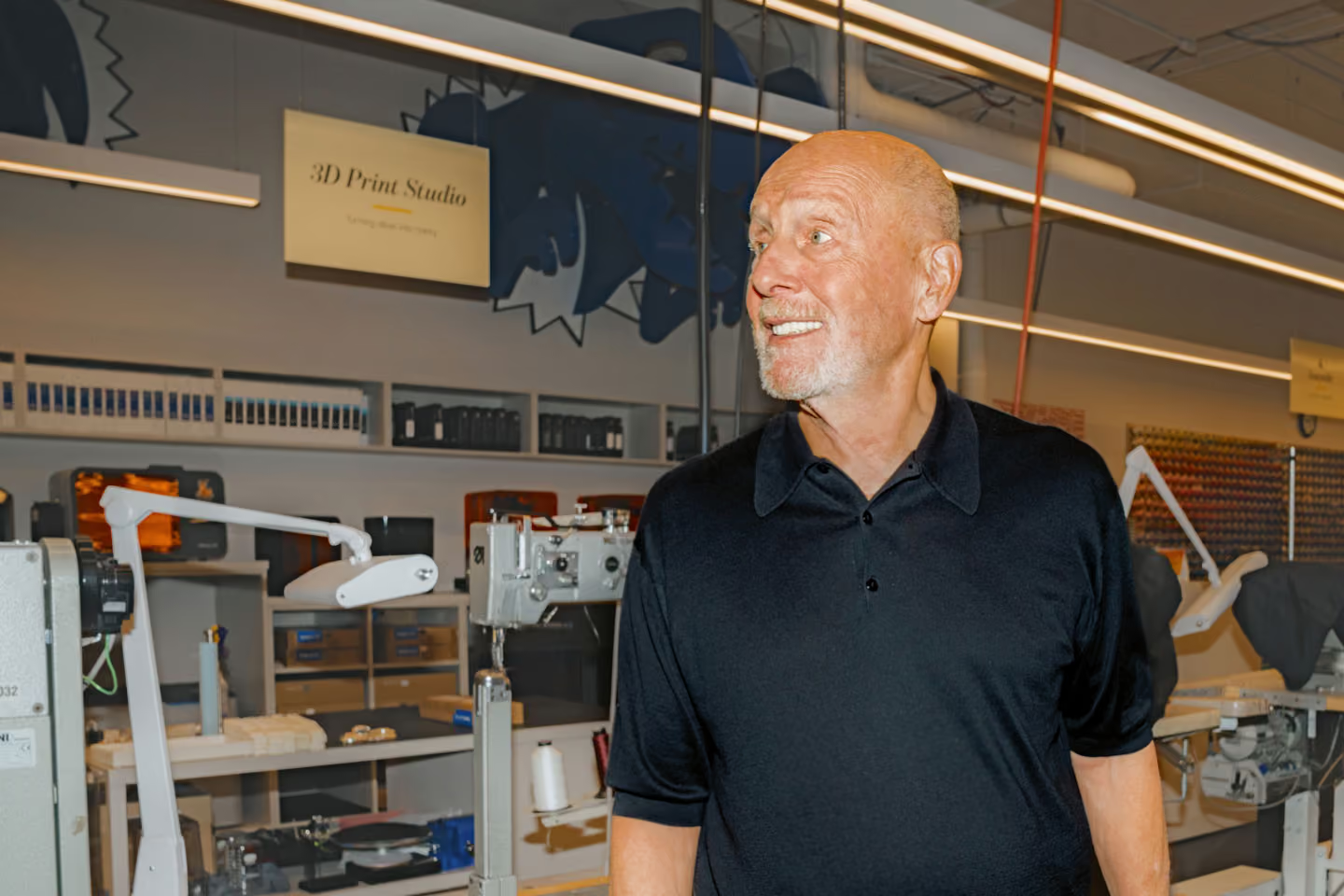
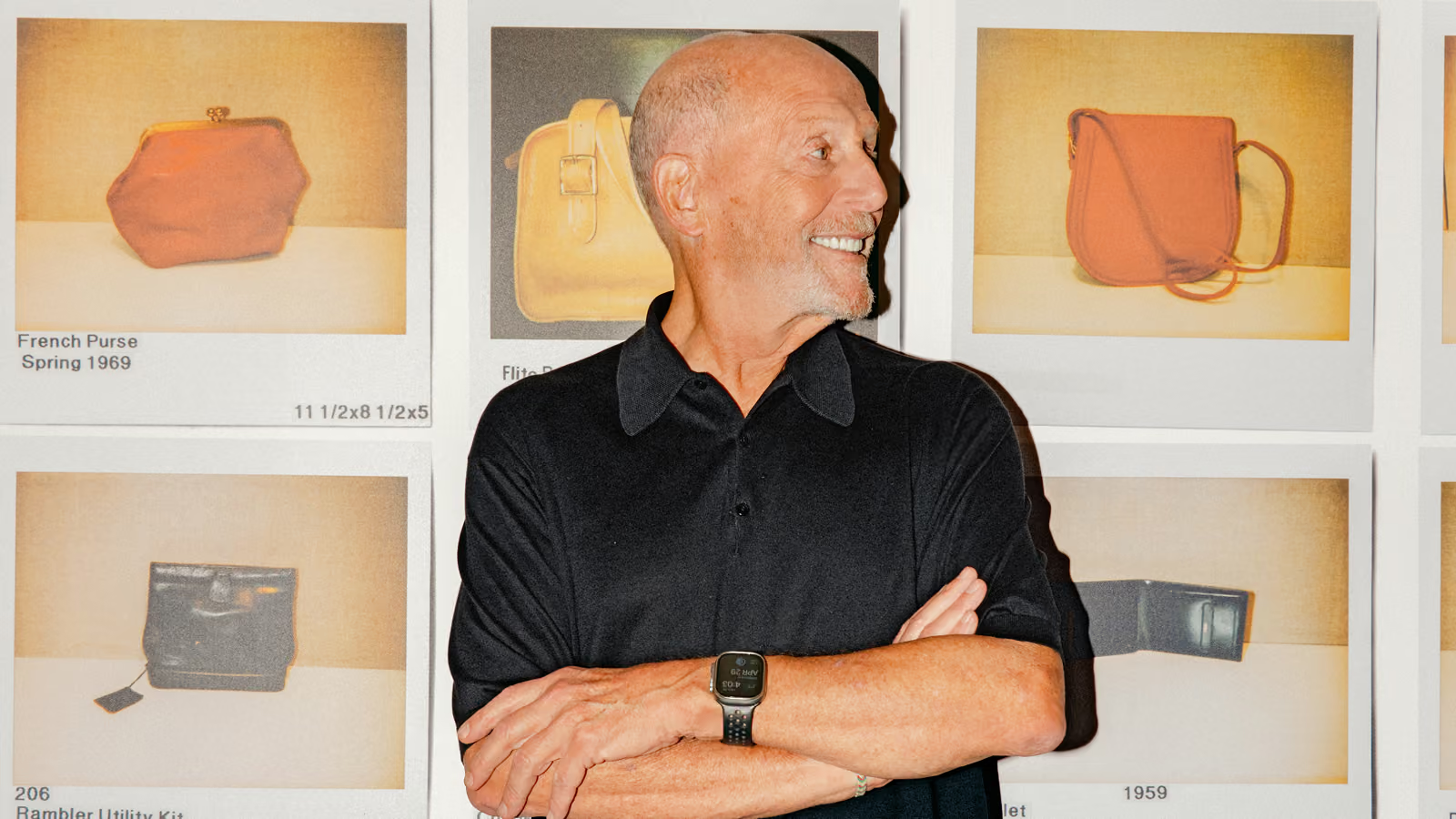
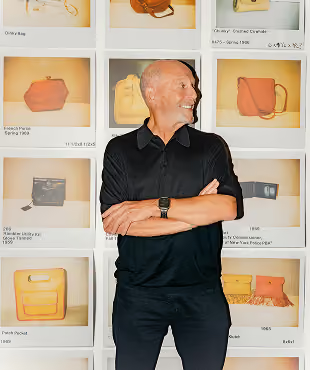
During this exclusive Think:Act photo shoot held at Coach headquarters, Lew Frankfort exhibited the same kind of ease and confidence that brought him to the once small leather goods company in the first place.
“For many consumers, Coach was luxury because they needed to save for it, but they only had to save for a week or a month – not for a year.”
A lot of high-end brands have chosen to go with the star power of designers and heads of creative who are celebrities in their own right. Does ingenuity and innovation need big names?
A small business that’s rapidly growing certainly benefits enormously, particularly since the digital age began, where everything can go viral by being recommended by someone whom they find trustworthy. Brands that are going through a transformation also could benefit from star power. For a brand that has hit a wall, the storytelling has to be integrated and authentic.
Has the internet and social media in particular changed that equation?
Thanks to social influencers and others, famous people have less impact than they did before. When you look at TikTok and YouTube, where young audiences are flocking, brands like Coach are maniacally focused on Gen Z. They may only represent 15-20% of total accessory spend today, but in 15 years, they’ll represent 40%, so understanding who they are, what their values are, and then developing strategies and programs to reinforce them is crucial.
The current leaders of Coach, CEO Todd Kahn and Creative Director Stuart Vevers, have brought the brand to new heights in its ninth decade. They have introduced recycled materials to address concerns around sustainability. They do significant customization, which young people are looking for to distinguish their bag from others. They’re also opening coffee shops adjacent to stores around the world, which helps create a community of like-minded people who might be visiting stores. They have found that sales in the stores go up significantly when you have a cafe next to it, and the cafes themselves are profitable, too. Almost everyone in the cafe is carrying a Coach bag, and there’s something magical about that. You can never stand still.
You left Coach in 2014, saying that your shadow was so long you didn’t even want to sit on the board. Is that an approach you’d recommend to other leaders who step aside?
It depends on where the leader is on their life’s journey and what they’re looking to do in their next chapter, and what the circumstances of the business are. In my case, I stayed about five years longer than I had thought I might. During those five years, I built my leadership team and identified three potential successors, one of whom the board ultimately chose. For many people, I was the personification of Coach, and there would still be an existing board, so it was clear to me that my successor would not have the freedom to move into directions different than those that I might pursue without my blessing. In this case, my successor decided that he wanted to reposition Coach as a house of brands, meaning through acquisitions, and also bring Coach to a higher level of modern luxury, which I felt was not consistent with the DNA of the brand.
You now run the Benvolio Group to make your own investments. If you look back on your 35 years at Coach, what is the one most important thing you took away from it that you can apply at Benvolio?
Two things: curiosity and good listening skills.






Stay ahead of the curve!
Sign up for our newsletter and let Think:Act bring you up to speed with what is happening today and guide you on what’s happening next.






.svg)
