
The final authority
Success in an AI-augmented workplace requires a fundamental shift in mindset. The goal isn’t to create humans who think more like machines. Rather, it’s to create working environments where human judgment and artificial intelligence enhance each other.
Sarah was gathering up the courage and the documents to apply for a loan to start a small business. The journey there wasn’t smooth sailing: She’d hustled hard to build a respectable credit score as a single mother and had worked to repair her life after a minor misdemeanor from a decade ago. On her way to her local credit union, she hoped that her good behavior since then would be enough to override her rap sheet. Less than 48 hours later, the rejection came. However, the decision hadn’t been made by a human, but rather an algorithm which had seen something in her profile that it categorized as a liability.
If an actual human had sat down and reviewed Sarah’s case, they might have decided her to be a trustworthy candidate. Sarah is what machine learning experts would call an edge case: a scenario that falls outside normal procedures and tends to be where artificial intelligence systems fail the most. But getting human eyes on a case like Sarah’s is under threat as corporations the world over are realizing that AI can make these kinds of assessments faster, cheaper and in many ways more consistently than the human loan officers.
As the AI revolution gains more and more speed, the world of work has been completely thrown into disarray. It’s the genie that can’t be put back into the bottle. In the early stages, the most pressing anxiety was the threat of obsolescence: that AI would automate away millions of jobs. Companies were throwing money at machine learning systems designed to remove human decision-making from the equation entirely. The promise was seductive; they were quicker and cheaper, and came without the messiness of human error. But a funny thing happened on the way to the automated future. The more powerful AI grew, the more essential human judgment grew in tandem.
As the AI revolution gains more and more speed, the world of work has been completely thrown into disarray. It’s the genie that can’t be put back into the bottle. In the early stages, the most pressing anxiety was the threat of obsolescence: that AI would automate away millions of jobs. Companies were throwing money at machine learning systems designed to remove human decision-making from the equation entirely. The promise was seductive; they were quicker and cheaper, and came without the messiness of human error. But a funny thing happened on the way to the automated future. The more powerful AI grew, the more essential human judgment grew in tandem.

Today, leaders are quickly realizing that the biggest change is no longer the dissolution of human workers. Rather, they’re coming to appreciate that one of the most important components of an AI-augmented workplace will be human judgment. The human touch is still necessary to be able to assess the limitations of AI for prediction and decision-making — something that is especially critical when it comes to data about people, such as in the case of Sarah and her loan. The big question is whether these considerations are being implemented as quickly as AI development and adoption itself are. In 2025, Matt Garman, the CEO of Amazon Web Services, told the media that soft skills such as communication and critical thinking will make human workers valuable for the foreseeable future. “I think they’ll be just as important, if not more important,” he said.
Mohammad Jarrahi is a professor at the University of North Carolina at Chapel Hill and his research focuses on understanding the consequences of AI in the workplace and the interplay between technology, people and organizational contexts. For him, the reaction among leaders has fallen into two camps: The first are the ones who think AI is an overhyped fad whose bubble will burst soon. The other extreme, he says, are the AGI maximalists: “People who are thinking the human edge is eroding and it’s pretty much just a matter of time until humans will be replaced.” Jarrahi doesn’t think either camp is on the money. But especially when it comes to the latter group of thinkers, what he thinks they fail to realize is that a lot of knowledge is not codifiable, he says. Take tacit knowledge: It’s knowledge built through practice and experience that, by definition, can’t be fed into a training run. It’s unlikely that AI will ever be able to replace that, says Jarrahi.
That’s where the idea of human-AI symbiosis comes in. There’s no questioning the awe-inducing capabilities of AI and its potential to automate the day-to-day drudgery of our jobs. But there are still segments of our work that, while AI may even do the initial bulk work, will require signoff from a human. We could view AI as something akin to a co-worker. “The problem is in the hyphen in human-AI interaction symbiosis,” he says. “Whoever picks that out, they’re gonna win the game.” In other words, the companies that work out how to most effectively pair humans with their AI counterparts will stand to gain the most.
Corporate leaders are having to determine in real time what this new AI-augmented world will look like. But some worry that the technology is being embedded at such lightning speed that it’s become impossible to erect the necessary safeguards to ensure issues related to privacy, biases and transparency are deeply considered. Call it the oversight paradox: Organizations built AI systems to reduce the need for human judgment. Instead, they’ve redistributed it. And the human touch is still required for those thornier decisions.
“The problem is in the hyphen in human-AI interaction symbiosis. Whoever picks that out, they’re gonna win the game.”

Catching what the algorithm misses
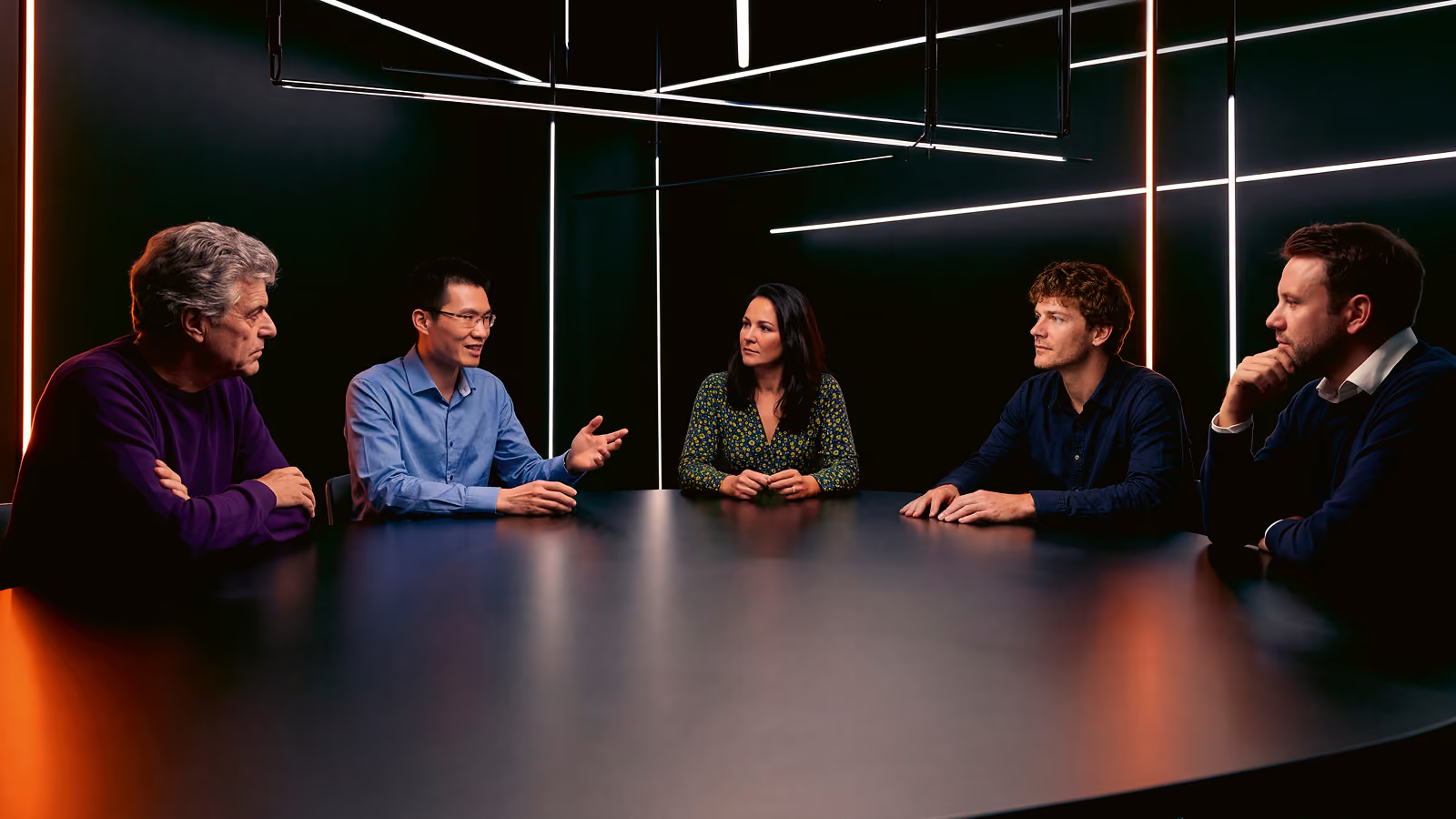
An algorithm can sort, flag and reject in seconds. What it can’t always tell is which case is worth a second look — the kind of judgment call that still needs a human hand and a trained eye.
When it comes to regulation, guardrails on the implementation of AI into business remain somewhat of a Wild West. Companies, for now, are relying on self-policing, enacting their own policies. The world will likely take its lead from Europe as we saw with GDPR, reckons Michael Impink, an assistant professor at HEC Paris focused on technological change and innovation and instructor of AI ethics in business at Harvard DCE’s Professional and Executive Development division. “I think we’ll probably see the same thing with the EU AI Act — a Brussels effect of Brussels regulating worldwide AI development,” he says. One remedy is what’s called human-in-the-loop, commonly used in finance and health care. This entails pairing a human with an AI system, to provide input at multiple points; an iterative feedback process where they can tweak and refine the outcome as it goes.
Erecting such a safeguard becomes particularly crucial in some sectors more than others. If an AI system denies a loan or flags a tumor, it’s crucial to be able to trace how that decision was made. But add the black box algorithms that GenAI runs on, “that means you can’t really audit some of these decisions,” says Jarrahi – so humans have to stay in the loop.

With this growing appreciation for the need for workers who can spot where AI goes awry, a similar shift is being reflected across the job market and hiring process. According to Indeed Hiring Lab’s 2025 AI at Work Report, almost half of the skills in job listings on its website are poised for “hybrid transformation” by GenAI, where “human oversight will remain critical when applying these skills” but AI systems can perform a large part of the work. Companies are hunting for a skill set that, until recently, wasn’t even on their radar: the ability to work with uncertainty and maintain a healthy skepticism toward automated systems.
This new future could mean that companies could begin to hire AI translators. These are individuals who work alongside decision-makers and help them understand what a set of AI insights mean and which to implement and which to discard, bridging the gap between the algorithm’s output and the messy reality of implementation.
Now, the value of soft skills is skyrocketing and nontechnical skills such as ambiguity tolerance and healthy skepticism will be mission critical. “The so-called soft skills like critical thinking and relationship management will be the much-needed skills of the future,” agrees Ifeoma Ajunwa, author of The Quantified Worker, founding director of the AI and Future of Work Program and the Asa Griggs Candler professor of law at Emory Law School. We’ll be in dire need of workers with the ability to “deploy critical thinking to discern between AI slop and valid AI outputs,” she says. It could be that the most advanced technology in human history will force us to recognize the value of the most fundamentally human skills.
Consider ambiguity tolerance. In the pre-AI workplace, ambiguity was often seen as a problem to be solved; standardize the process, clarify the requirements, eliminate the uncertainty. But AI systems struggle with genuine ambiguity. They need clean categories and clear parameters. When reality doesn’t fit those constraints, humans will have to step in. “One of the roles of humans in the era of AI is exception handling,” says Jarrahi: stepping in to make a call on a borderline case, like Sarah.
“The so-called soft skills like critical thinking and relationship management will be the much-needed skills of the future.”
LEARN TO SPOT THE DIAMONDS
As AI shapes more of the information we encounter, the ability to distinguish useful insights from convincing noise has become an increasingly valuable workplace skill.

Then there’s ethical reasoning. AI systems optimize for whatever goal they’re given, without moral consideration. If the goal is to maximize quarterly profits, the AI will find every possible way to do that, including ways that humans would immediately recognize as unethical or shortsighted. In place of asking candidates about their experience with specific software or methodologies, companies could start to present interviewees with ambiguous scenarios and evaluate their ability to question an algorithm.
The demand for these kinds of workers is going to increase, reckons Impink. And at the same time, the supply may suffer if the companies hiring these workers fail to uphold best practices when it comes to how they deploy and govern their AI. “One is the demand side being the sense that these types of employees probably want to work at specific places and so they’re only going to make themselves available to certain companies,” he says. “And so, to get the top talent, maybe the companies have to adopt more ethical practices,” he adds.
What’s becoming clear is that success in an AI-augmented workplace requires a fundamental shift in mindset. The goal isn’t to create humans who think more like machines. It’s to create working environments where human judgment and artificial intelligence enhance each other – where the human asks the questions the algorithm can’t and the algorithm processes information at a scale the human can’t. What gives Ajunwa hope for the future are “the companies hiring AI ethicists and hosting AI advisory councils to critically review or audit AI systems before adopting them wholesale,” she says. “Companies that fail to do this are inviting disaster as they might be falling for AI hype rather than realistic claims.”
Some companies are bucking the trend. IBM recently announced that it would be tripling its entry-level hiring, rewriting roles across sectors to account for AI fluency. It will be the candidates who can demonstrate comfort and initiative with AI systems who will nab these positions, the company said. This is the new expertise that the workplace will need most: the deeply human capacity for judgment. It turns out that what made human judgment inconvenient is precisely what makes it indispensable: Numbers can never tell the whole story.
Some companies are bucking the trend. IBM recently announced that it would be tripling its entry-level hiring, rewriting roles across sectors to account for AI fluency. It will be the candidates who can demonstrate comfort and initiative with AI systems who will nab these positions, the company said. This is the new expertise that the workplace will need most: the deeply human capacity for judgment. It turns out that what made human judgment inconvenient is precisely what makes it indispensable: Numbers can never tell the whole story.







Stay ahead of the curve!
Sign up for our newsletter and let Think:Act bring you up to speed with what is happening today and guide you on what’s happening next.







.svg)
