
Sustainability under pressure: why business shouldn’t back down on climate

How do you lead in a time of growing skepticism and pushback on the green agenda? It might be a simple case of “keep calm and carry on.” Beneath the political noise and culture war rhetoric, many companies still see a strong commercial case for sustainable business.
Donald Trump only agreed to attend the World Economic Forum in Davos in January 2026 after his team received confirmation from World Economic Forum (WEF) officials that there would not be an excess of so-called “woke” items on the agenda. A well-sourced report in the Financial Times the previous November revealed that “senior US officials had asked Davos management to tone down or avoid discussions on areas including female empowerment and diversity, the green transition, climate change and international development finance as a condition of his participation.”
While WEF officials denied firmly that the White House had in any way dictated terms for the annual meeting, another WEF observer conceded that of course plans are laid with representatives ahead of the main event. “It is normal that topics and discussions for stakeholders attending the summit would come up,” they said. Viewed generously, this sort of pre-conference discussion could be seen as being part of “the spirit of dialogue.” And, in fairness, acknowledging that prosperity has to be built “within planetary boundaries” remained one of the five official pillars of Davos this year.
There is no pun intended here, but the climate has clearly changed for business leaders as they consider how to manage their organizations sustainably in this developing Trump-influenced era. And it would be wrong to point the finger solely at the 47th US President for causing a certain amount of rethinking and recalculation.
The tech billionaire and philanthropist Bill Gates published an extended memo ahead of last autumn’s United Nations climate summit, COP30. In it he said that the “doomsday” view of climate change was overdone. While he did not deny that the world continues to face a major problem with global warming, he felt that panic and despair are uncalled for. “Although climate change will have serious consequences – particularly for people in the poorest countries – it will not lead to humanity’s demise,” he wrote. “Emissions projections have gone down, and with the right policies and investments, innovation will allow us to drive emissions down much further.”
Gates’ intervention is part of the backdrop to a clear reluctance among global CEOs to speak up on climate issues. What explains this reticence? “It’s not that they don’t believe [in climate change] or they don’t want to move forward. They’re just scared. I’m shocked by how frightened CEOs are,” former US presidential candidate, secretary of state and climate envoy John Kerry told the Financial Times. “The process of Donald Trump in the last months, coupled with the justice department, coupled with his vengeance programs, has scared the crap out of a lot of people,” he said after speaking at London’s Chatham House last November. Trump’s skepticism on climate change – he has called it “the greatest con job ever perpetrated on the world” – is well known. “The only hoax is in pretending otherwise,” Kerry countered. “I’ve learned that, in an election for a time, you can bend the laws of politics. But believe me, no one, no president, no monarch, no one, can bend the laws of physics.”
Even though massive, multibillion-dollar investments in renewable energy continue, Kerry observed that “CEOs who were most bullish about climate solutions have … just pulled it back, afraid that climate isn’t good for business, or politics, or just afraid.” A 2025 survey of 1,200 global CEOs by the executive search and advisory firm Egon Zehnder confirmed this hesitancy. Less than half of those surveyed – 40% – said they should engage externally on issues of global prosperity and stability. This tension was reflected in another of the survey’s findings: While 25% said their main responsibility is to shareholders and financial performance, only 3% said they should leave global issues to governments and international institutions.
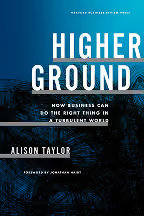
One of the most forthright and effective analyses of these and other dilemmas facing corporate leaders has been done by Alison Taylor, clinical associate professor of business and society at the Stern School of Business. In 2024 Taylor published her acclaimed book Higher Ground: How Business Can Do the Right Thing in a Turbulent World. Her work involves a close study of ethics and sustainability leaders in a range of corporate settings. “If you work in sustainability, it is very difficult not to drift toward either activism or conformity, to the detriment of effectiveness,” she says. “If you are too much of an activist, you lose internal credibility fast. Conversely, if you are too technocratic and biddable, you will be sidelined for other reasons. Worst of all, you can wind up prioritizing optics, winning awards, and showing up on panels, but getting very little else done.”
“If you work in sustainability, it is very difficult not to drift toward either activism or conformity, to the detriment of effectiveness.”

A living whole
Granting the Whanganui River legal rights promotes its intrinsic interests, yet also grants us the opportunity to understand our own obligations and rights, and the duties and constraints of public authorities, in new ways.
In spite of legitimate and pressing concerns about the challenging context facing business leaders, beneath the headlines and the rhetoric, good work continues. And COP30 was not a washout. As many as 60 Fortune 100 companies were in attendance in Belém, Brazil, up from the 50 that attended the previous COP in Baku, Azerbaijan, according to a Reuters survey. And some business leaders were ready to speak openly about their sustainability and other “green” activities. “We’re doing it because it’s good for the business. It helps create supply security,” PepsiCo’s chief sustainability officer, Jim Andrew, said. “We need farmers to be successful, we need them to keep farming.”
The global market for sustainability consulting advice also reached $54 billion by the end of 2025, according to Source Global Research, a data monitoring business which studies the consultancy market. Growth was as high as 5% in 2025, up from 3.9% a year previously. Work covered by the label ESG (environment, social, governance) forms part of much of the consulting work going on: As many as half of the firms studied by Source Global Research said most of their consultancy work involved ESG considerations, while 21% said all their work did. There is also the nontrivial matter of businesses needing to make restatements of sustainability data, a not uncommon occurrence.

A bridge to nowhere
Built in the 1930s to serve farming settlements that never took hold, this concrete bridge now stands alone in the rainforest along the Whanganui River – reachable only by boat, foot or bike.
While the concept of purpose is much discussed these days, it is not a new debate. In 1995, the academics Sumantra Ghoshal and Christopher Bartlett published a paper called Changing the Role of Top Management: Beyond Strategy to Purpose. They wrote: “Strategies can engender strong, enduring emotional attachments only when they are embedded in a broader organizational purpose.” Almost 30 years later, two new books bring us up to date on the discussion around purpose in the context of recognizing (and combating) the reality of climate change: Beyond Profit: Purpose-Driven Leadership for a Wellbeing Economy, by Victoria Hurth, Ben Renshaw and Lorenzo Fioramonti; and The Purpose-Driven Organisation in Times of Climate Crisis, edited by Katie Bailey and Katie Manning.
Hurth says that we have reached an “emperor’s new clothes” moment where it is clear that our current system is failing us and yet there is a lack of necessary action. “It’s like we’re all on a bus, we can’t get off, and the control panel and steering wheel are set to ‘go over cliff,’” she says. “We need a new control panel – that means better governance. If we don’t turn the steering wheel to ‘purpose’ then we are going over the cliff.” Hurth and her co-authors are radical on the need to adopt new priorities to achieve sustainable success. “If we want fast, effective change then we need to give up ‘pragmatically’ trying to tweak a system set up to financially serve itself and instead align stakeholders with the long-term good of the collective,” they write. “This alignment infuses the organization with a shared sense of meaning and direction, creating a unified and motivated culture,” they say.
The three faces of corporate purpose
The Purpose-Driven Organisation in Times of Climate Crisis, edited by Katie Bailey and Katie Manning, expands on three different approaches to purpose and sustainability.
Respond to evolving disclosure mandates and financial reporting standards. For these firms, sustainability efforts are often shaped by the need to maintain market access and mitigate potential legal or reputational risks.
Embed long-term environmental considerations into corporate governance and capital allocation. Their engagement reflects a broader commitment to climate action as a fundamental business principle.
Focus on identifying opportunities within purpose and sustainability, leveraging efficiencies, cost reductions and shifting consumer and investor preferences to create competitive advantages.
Katie Bailey says that a reframing of the climate change narrative is required. “The top-down approach of scaremongering hasn’t worked,” she says. “It’s not the kind of thing business responds to very well.” Sustainability is about risk management but it is also about opportunity, she adds. We need “strategies for renewal and innovation. Opportunity – how does it attract talent and capital?” Business can change, but not because of compliance and fear. “How do we make this a positive movement toward something meaningful?” Manning adds. In Bailey and Manning’s book there is an extensive discussion on effecting change. They write: “Ultimately, purpose-driven leadership is not about choosing between profit and impact; rather it is about aligning them. Leaders who challenge the status quo, model ethical decision-making and empower employees at all levels pave the way for organizations that thrive in both business success and societal contribution. Purpose cannot be treated as an optional add-on. Instead, it should be used as a transformational force that fuels innovation, strengthens relationships and drives long-term value.”
“Companies aren’t being put off by the noise. They’re doing it for sound strategic reasons: a mix of economics, finance and social acceptability.”
For a reality check on the practicalities implied by some of this analysis, Think:Act Magazine spoke to Sebastian Munden, chair of the global board of trustees for WRAP (the waste and resources action program, an NGO working to build a circular economy) and also global chair of Ad Net Zero, the advertising industry’s program to deliver net-zero ways of working. Munden was in New York for Climate Week in 2025 and then later in Brazil for meetings around the COP30. He takes a calmly pragmatic view of the controversies which currently surround the sustainability debate. “I think the politicization of some of these things will ultimately be seen as a massive distraction,” he says. “Business will carry on doing them because they’re simply good business.”
He cites the example of tackling food waste. “For some people it’s about redistribution of surplus – so there’s a social angle to it. And for others the motivation is reducing wasted carbon and greenhouse gases. If you’re a supermarket or food producer, it’s wasted margin.” He adds that “what we saw in Climate Week in New York was the companies that aren’t being put off by the noise. They’re doing it for sound strategic reasons, which are a mix of economics, finance and social acceptability.” The win for business goes far wider than advertising and marketing, Munden says. “I think carbon has become, for those companies who have really got into it, a currency for savings and a trigger for innovation, because effectively it’s an indicator of wastefulness.”
Life, and business, must go on. That’s the bottom line. Politicians will come and go, along with the noise that they make from time to time. But sensible (and successful) business leaders will, in the words of the wartime advice, “keep calm and carry on.” Business will continue to strive to be both profitable and sustainable – an imperative for the general and the common good.
He cites the example of tackling food waste. “For some people it’s about redistribution of surplus – so there’s a social angle to it. And for others the motivation is reducing wasted carbon and greenhouse gases. If you’re a supermarket or food producer, it’s wasted margin.” He adds that “what we saw in Climate Week in New York was the companies that aren’t being put off by the noise. They’re doing it for sound strategic reasons, which are a mix of economics, finance and social acceptability.” The win for business goes far wider than advertising and marketing, Munden says. “I think carbon has become, for those companies who have really got into it, a currency for savings and a trigger for innovation, because effectively it’s an indicator of wastefulness.”
He cites the example of tackling food waste. “For some people it’s about redistribution of surplus – so there’s a social angle to it. And for others the motivation is reducing wasted carbon and greenhouse gases. If you’re a supermarket or food producer, it’s wasted margin.” He adds that “what we saw in Climate Week in New York was the companies that aren’t being put off by the noise. They’re doing it for sound strategic reasons, which are a mix of economics, finance and social acceptability.” The win for business goes far wider than advertising and marketing, Munden says. “I think carbon has become, for those companies who have really got into it, a currency for savings and a trigger for innovation, because effectively it’s an indicator of wastefulness.”







Stay ahead of the curve!
Sign up for our newsletter and let Think:Act bring you up to speed with what is happening today and guide you on what’s happening next.








.svg)
