
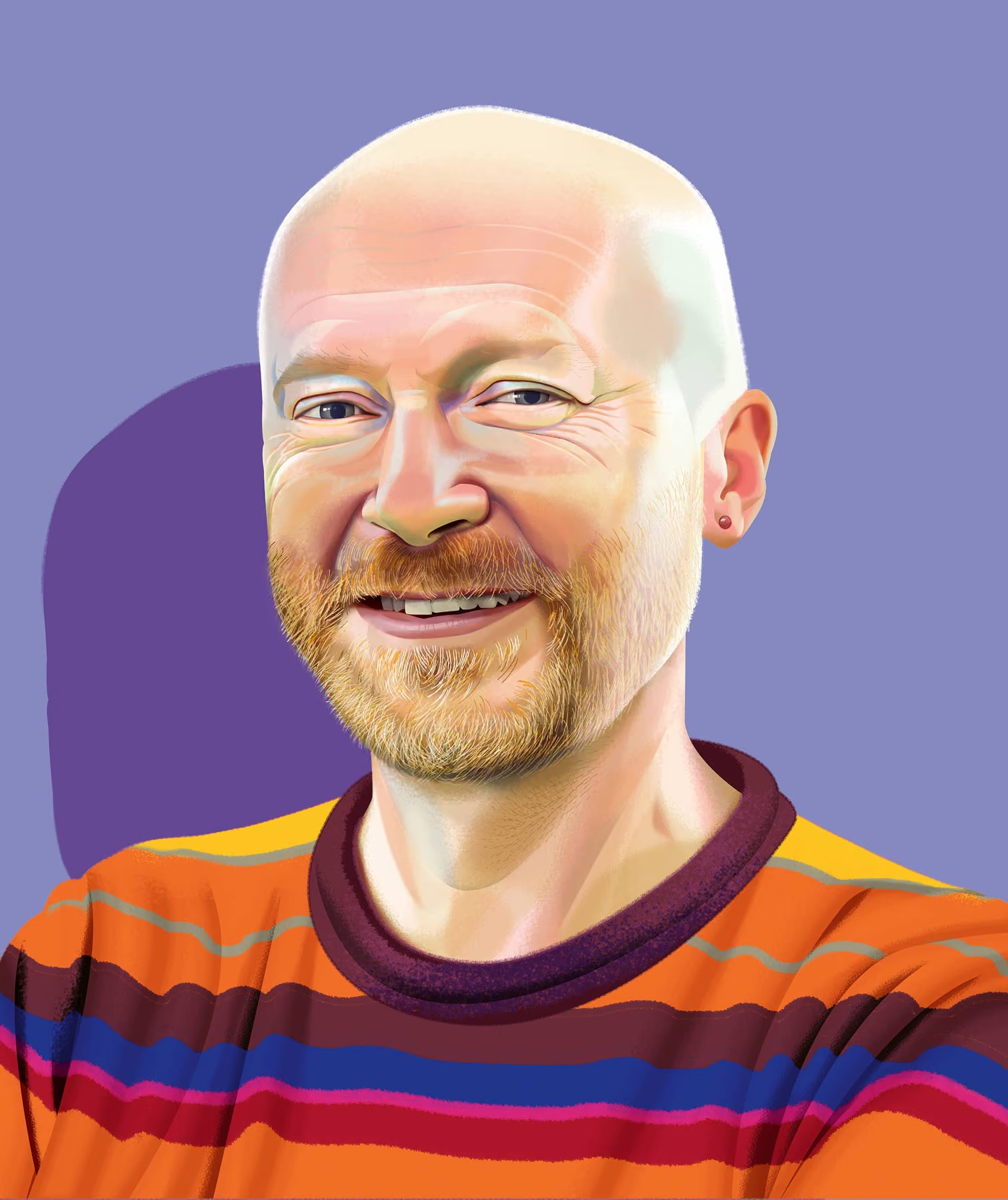
Marcus du Sautoy on the mathematics of creativity
A rare mathematician who is also deeply embedded in the arts, British academic Marcus du Sautoy draws similarities between the two fields in this interview and explains whether AI art can be considered real art.
In what ways do you think mathematics and art are similar?
Defining creativity is quite a challenge. Cognitive scientist Margaret Boden defines it as something which is novel, surprising and has value. Novelty is the surprise about your emotional reaction to the thing. Value is whether that actually helps you in some way. People think mathematics is just about proving theorems about numbers and geometry, so where’s the creativity in that? But it’s not about proving everything that’s possible. It’s about making choices around those stories about numbers and geometry that we think have an interesting emotional journey to them.
Music and mathematics have a lot of connection, because music is quite an abstract world where the development of pattern is quite important to the aesthetics of listening. For mathematics, it’s about the choices of strange connections, a kind of jeopardy in an argument, the joy of seeing that two things that look totally different are actually related.
Mathematics actually requires those elements of creativity. They need to be new, but they need to have emotional engagement, surprise and value, because you want those discoveries to change the way we see the world.
Music and mathematics share patterns and structure, which implies a certain sense of predictability.
Mathematics is the science of patterns. The idea of spotting a pattern has been very crucial in our evolutionary development: If we’re able to spot a pattern, we can plan into the future. It gives you a very powerful tool to navigate your way through time and space. You can almost talk about music as the art of pattern. Mathematics could also be defined as the study of structure. Some structures are very predictable and not interesting, but many structures have really surprising twists and turns in them.
Creative artists love structure. If you have total freedom and are given a blank page, a blank stave or a blank stage, it’s very hard to be creative. Igor Stravinsky said: “I can only be creative under huge constraints.” Often people are looking for interesting structures whose constraints allow them to be pushed into interesting new directions. Why does Shakespeare write in iambic pentameter or write sonnets? Because often in that structure, the predictability is some of the aesthetic: You enjoy knowing that you’re going to arrive at something which rhymes with the words several lines previous. Artists love wrestling with the tension, that structure produces predictability and unpredictability within itself. And the idea of setting up expectations which you then break. You need structure in order to sometimes break out and do something different. If there was too much freedom, you wouldn’t appreciate that break of structure.
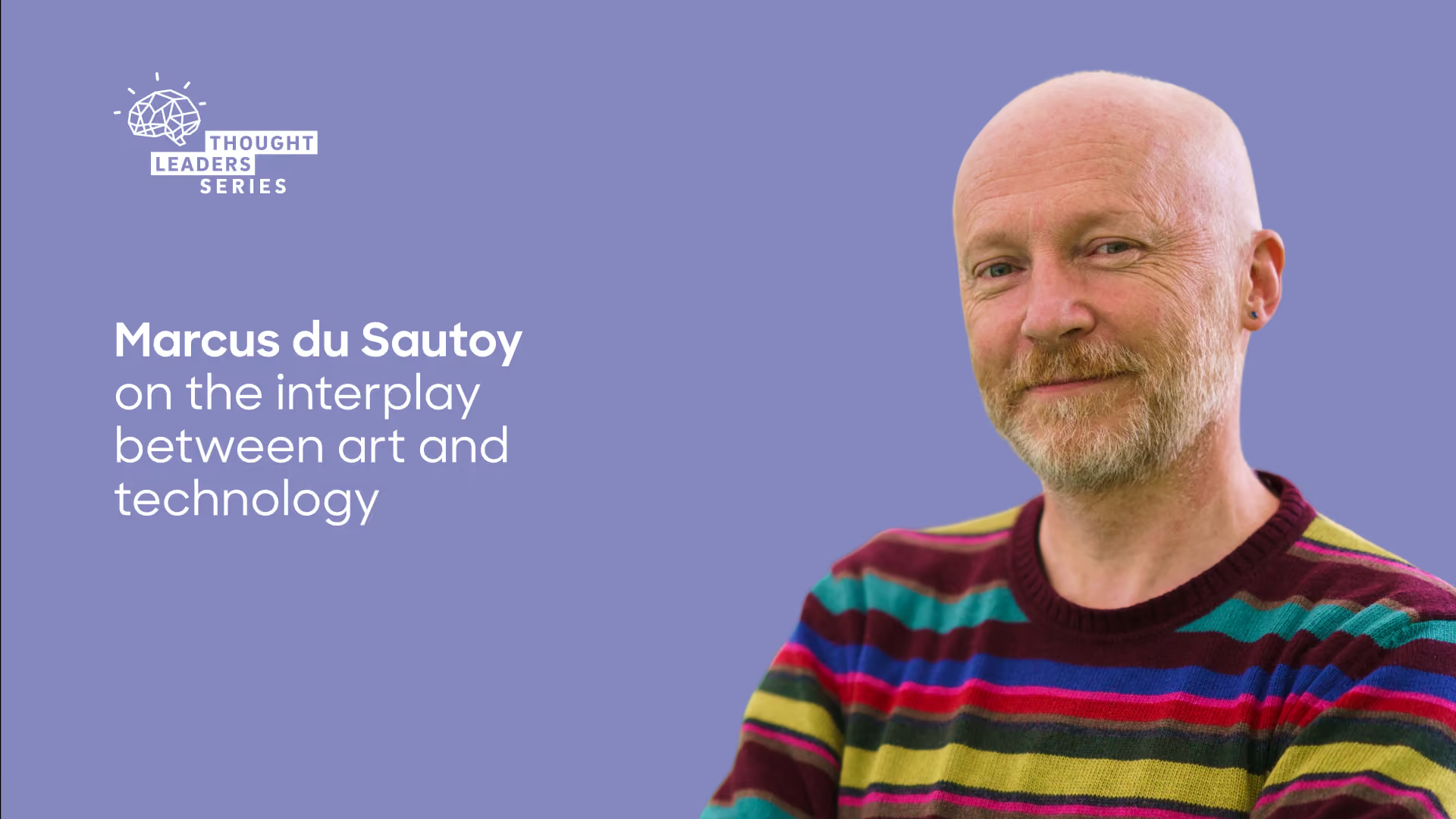
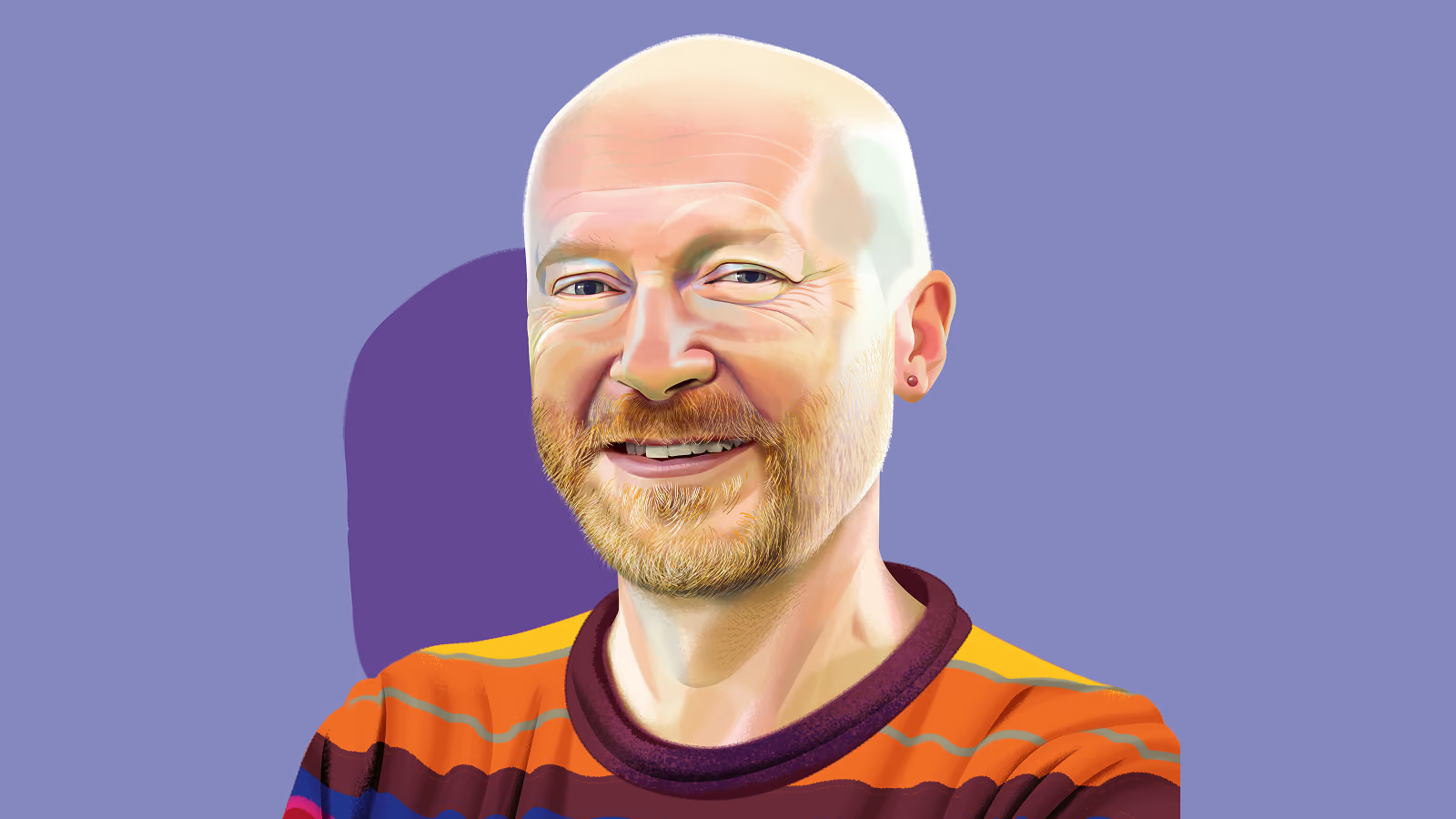
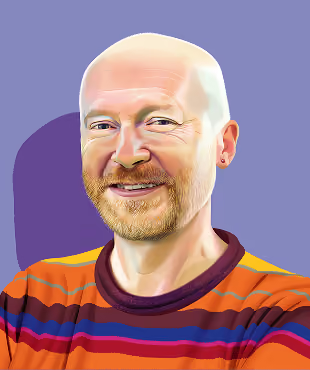
Professor for the public understanding of science at Oxford University, BBC presenter and author of The Music of the Primes and The Creativity Code, Marcus du Sautoy’s accessible approach to mathematics was awarded with the Royal Society of London’s prize for excellence in communicating science to UK audiences in 2009. This interview was conducted via the Global Peter Drucker Forum.
Look out for secret mathematicians in the arts

Shakespeare
Iambic pentameter is the base of his oeuvre, indeed, yet the Bard also made frequent use of math in his prose, referencing the rapid progress of his era.

Olivier Messiaen
Working with prime numbers, among other tools, the French composer used math to defy conventional repetition and explore a new sense of time.

Radiohead
The UK band is known for complex, mathematical compositions. Their guitarist, Jonny Greenwood, has cited Messiaen as a major influence.
“Why does Shakespeare write in iambic pentameter? Because the predictability is some of the aesthetic.”
What connections do you see between constraints and innovation in the world of management?
Innovation is very closely tied to the ideas of creativity. Structures can be too constraining. Sometimes the challenge in the creative realm is to move away from received structures in order to see if breaking something takes you somewhere new or collapses the system.
There are three sorts of creativity as per Margaret Boden: Exploratory creativity, which is within the constraints that you’ve got, pushing things to their extreme to see what is possible within that world. Combinational creativity, which is about taking insights from another realm and seeing whether the way they think about their product or their way of doing things, is something you can use in your realm. The idea of combining structure from one place, which perhaps has been built for that, with your own, is very strong. Then there’s transformational creativity, which is about breaking rules, seeing the structures and saying, if I break this, does something interesting happen? If you think about cubism or Arnold Schönberg’s twelve-tone row or modernism in literature, that was very much about breaking out of the constraints of the 19th century and moving into the 20th century.
Shifting gears to AI – is it good news for creative professionals?
AI is an interesting new tool for creatives. A lot of people in the creative realm feel threatened by it. There are a few people who know how to manipulate this new tool to do something genuinely new. Bernard Lubat, a jazz musician, trained an AI on his jazz improvisation style. He played a concert with this piece of AI behind a screen. The audience couldn’t tell who was AI and who was human. Lubat’s response was, “I recognize everything that the AI is playing: It’s me, it’s my world, but it’s doing things I’ve never ever thought of doing before.” AI can take your world of creativity and show you things within that world that you’ve missed, or new opportunities. Think of it like Galileo getting a telescope and being able to see things for the first time deep into the solar system. This is like a digital telescope which is allowing us to see things which perhaps our embodiment is limiting us to see.
AI is an interesting new tool for creatives. A lot of people in the creative realm feel threatened by it. There are a few people who know how to manipulate this new tool to do something genuinely new. Bernard Lubat, a jazz musician, trained an AI on his jazz improvisation style. He played a concert with this piece of AI behind a screen. The audience couldn’t tell who was AI and who was human. Lubat’s response was, “I recognize everything that the AI is playing: It’s me, it’s my world, but it’s doing things I’ve never ever thought of doing before.” AI can take your world of creativity and show you things within that world that you’ve missed, or new opportunities. Think of it like Galileo getting a telescope and being able to see things for the first time deep into the solar system. This is like a digital telescope which is allowing us to see things which perhaps our embodiment is limiting us to see.
Aesthetics count on math
All architects depend on math to keep their structures standing, but some even build its concepts into their aesthetic. Palladio and Le Corbusier, for example, may have worked 400 years apart, but both used the golden ratio and the Fibonacci sequence.
Art has an emotional aspect. You are drawn to a Gustav Klimt because you know a bit about his own evolution as an artist, so you understand the significance of his art. When AI creates art, is it really the same?
At Art Basel, a gallery displayed paintings that were done by humans and some by AI, but the visitors weren’t told that. They were asked which paintings they emotionally engaged with. Intriguingly, a lot of the AI paintings were the ones that people had the most emotional reaction to. When they were told that these were created by AI, they felt cheated. You want your art to connect to the emotional world of the creator. The AI was trained on human art, on our emotional world. So, it’s not surprising that data that comes out of that AI learning from our emotional world will have an emotional content to it.
In your book The Creativity Code, you talk about the Pollockizer, the pendulum that mimics Jackson Pollock’s art style. It may produce art that is visually similar to his, but is it really the same?
Pollock’s paintings have a unique quality to them which is quite mathematical: They are fractal in nature, they have an interesting, scaleless property. You can reproduce this using a chaotic pendulum. This is probably how Pollock produced this geometric style, because he was almost dancing as he painted. He was making a lot of very deliberate decisions about where to place the paint, add more paint and the color palette. He was responding to the natural world around him.
If you use a chaotic pendulum, the Pollockizer, it will have some qualities of Pollock. But that emotional connection of the man to the natural world around him and the decisions and choices that are made on top of using this particular style of painting are what will distinguish a Pollock from something generated by the Pollockizer.
I did an experiment to see how and what the Pollockizer would produce. And it wasn’t anywhere near the emotional reaction you get of feeling like you’re in front of an abstract version of the natural world when seeing a Pollock. You can measure the dimension of these fractals, and Pollock goes through quite a range of different dimensions. The ones we emotionally react to are those whose dimensions in the painting are closest to the fractal dimensions we see in nature. The Pollocks we love, that are valued both financially and emotionally, are those where Pollock himself is most closely capturing nature.
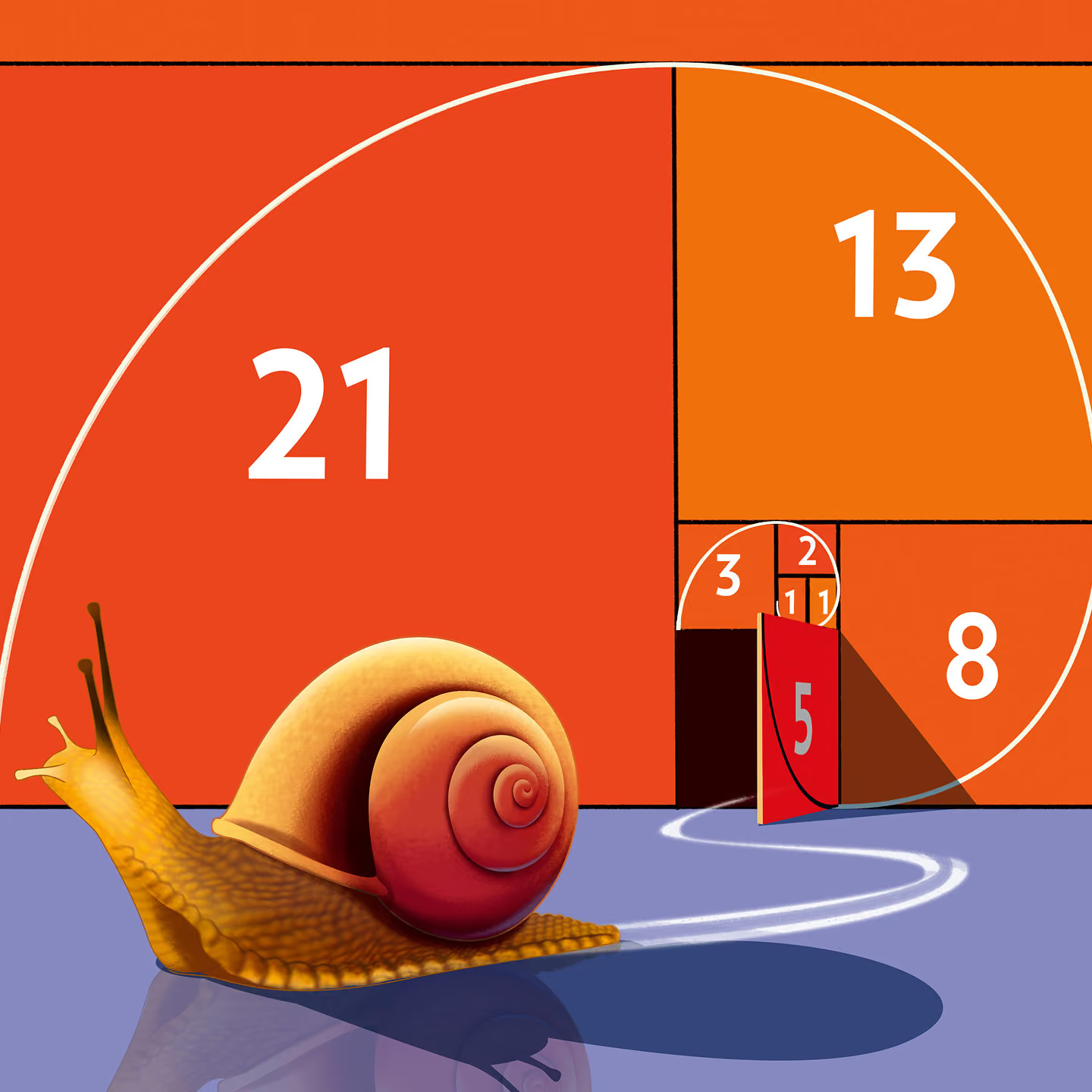
The golden ratio, one shell at a time
Each new chamber in a snail’s shell is sized to the sum of the two before it, tracing the same golden spiral that architects like Palladio and Le Corbusier borrowed for their own designs. It’s exactly the kind of naturally occurring pattern Marcus du Sautoy points to as evidence that mathematics is, at its core, the science hidden inside nature’s most ordinary structures.
Will AI ever push the boundaries in art, or will it always remain rooted in what is already familiar to us?
A lot of the criticisms of people are that AI is just reproducing style. You can have your portrait done in the style of Van Gogh or Picasso. That’s not really creative. It’s pastiche. But we do have some very interesting algorithms that actually push us into the new.
I was particularly excited by the idea of a generative adversarial network (GAN), which is two algorithms. One learns about style and understands what has been done. The second is tasked with creating something which tries to move away from the space of the known into the unknown. The first algorithm either says, “Oh, no, I’m sorry, I still recognize that style. It’s too close to something that’s already been done.” Or the other side is that perhaps it moves too far away, and we don’t recognize it as something which we would regard as art.
There’s something in psychology called the Wundt curve, which is about one’s hedonic reaction to new things. If you make something too challenging, we have a negative hedonic reaction, whilst if we push a little bit outside of the new but not too far, there’s a kind of sweet spot where we go, “that is really interesting.” These GANs are genuinely tasked with taking you into the new.

Stay ahead of the curve!
Sign up for our newsletter and let Think:Act bring you up to speed with what is happening today and guide you on what’s happening next.

.svg)
