
A leadership guide for the AI era
It gives you superpowers. It dulls your cognitive capabilities. It makes you more productive than ever. But it could also make you obsolete. Getting your head around AI’s vast opportunities is a high-wire act of dizzying proportions that demands our full curiosity.
Humanity is directing ever more powerful tools toward the heavens to hunt for signs of alien life. By early 2026, astronomers had identified close to 6,100 so-called exoplanets, or celestial bodies orbiting a star like Earth does the Sun. There are likely millions more, and some of them could well be harboring life.

What can I help with?

Yet a new life-form may already be among us, right here on Earth: artificial intelligence. Much like an alien species that dropped from the sky, it took us by surprise and is rapidly evolving. What’s even more perplexing is that we ourselves are the creators of this species with which we will coexist and at times may well compete for access to resources and attention. This hypothesis no longer sounds far-fetched, and it raises daunting questions around the very essence of human agency and leadership.
What will this symbiosis or mind-meld between humans and AI look like? Which skills do tomorrow’s leaders need to acquire, and how will they manage workforces that might do away with time-honored apprenticeships and could soon include legions of robots and synthetic employees? What will corporate culture – a decidedly human social construct – look like going forward? How to address the looming disruption of national economies and labor markets in particular? And what are today’s students and graduates to make of this new world where they might be competing with or reporting to sentient software?
This edition of Think:Act deliberately embraces the uncertainty and potential of becoming artificial in all its facets. Unlike many other innovations, AI is a horizontal technology – meaning it touches literally every aspect of human life. It’s a ubiquitous resource embedded in everything, ready for infinite purposes and uses that have yet to be dreamed up, akin to electricity, gas or water. According to one broad survey by central bankers and academics in the US, UK, Germany and Australia, roughly 70% of firms have already adopted AI, but its effects on employment and productivity remain small, notwithstanding all the hype and hyperventilating.
This much is clear: Today’s leaders must quickly appraise the still-evolving landscape and chart a rough path through it, and under circumstances of great uncertainty at that. They need to get up to speed with a new language that is intended for interspecies communication and develop new skills when it comes to defining and refining their company’s goals. And then turn around and disseminate their insights, apprehensions and aspirations among their teams if they want to accomplish broad buy-in. Only then do organizations stand a chance to unlock the vast potential AI undoubtedly offers.
We have chosen to give the stage to five eminent thinkers from the world of technology and business to address the promise and perils of AI, followed by another five luminaries in the next issue. After this tour d’horizon, we will explore individual topics every leader should care about, from becoming AI-literate to remaining curious and acting with competency to use it across the entire organization, to being resilient or playing the long game with AI by their side.
Straight from the experts

Gary Marcus is professor emeritus of psychology and neural science at NYU and founder of Geometric Intelligence, which was acquired by Uber. A prominent AI skeptic, his expertise spans cognitive architecture and the limitations of AI. His most recent book is Taming Silicon Valley (2024).
What is your greatest hope and your greatest fear for the coming age of AI?
My greatest hope is that we make AI a positive force for humanity, which would require a different approach than we have now, to really fulfill its promise in science, medicine, etc. And that we as a society learn how to not just regulate, but coexist with AI in a way that is humanity-positive. My worst fear is that AI is becoming a tool for authoritarians and will be bad for most people in society.
What’s the riskiest dead end that current AI research and commercial deployments might go down today — or are already going down?
All this obsession with large language models (LLMs) is a mistake. They’re very expensive to build. They’re very unreliable by the nature of how they’re constructed. You can’t really trust them. They’re not really good with facts. It’s already becoming clear that we spent the last five years pursuing the wrong road. I’m very supportive of world models. I don’t think anybody knows how to do it right, but we absolutely need to work on them. There’s no physical law of the universe that says that you need magic biology in order to do it.
How will the nature and essence of leadership evolve as AI becomes more pervasive?
Leaders have to ask themselves a question right now: Do they want to look out for the long-term value of humanity, or do they just want to make a buck? They can think about what kind of society they want to have, and as leaders, they have a role in shaping that.
What areas of decision-making should stay reserved for humans and not be encroached upon by AI systems?
In the long term, it might be that AI does them all better than people. In the short term, I don’t think it does any better than the best people, maybe better than people who don’t have expertise. I worry about the ethical side. We build machines that are basically amoral and don’t really understand ethical decision-making at all.

Sinan Aral is the David Austin professor of management, marketing, IT and data science at MIT Sloan and director of the MIT Initiative on the Digital Economy. His research focuses on social media, AI, misinformation and digital networks. Aral is the author of The Hype Machine (2020).
What is your greatest hope and your greatest fear for the coming age of AI?
This is the most consequential technology humanity has ever produced. The age of AI will be more impactful to the world than the Agrarian Revolution and the Industrial Revolution combined. We are on the precipice of a tremendous amount of change, and there is great promise and great peril in that potential. What scares me the most are the rapid changes in the labor force and how little time we have to adapt, reskill and change our processes and education.
Who should be more worried about being made obsolete or replaced: leaders, middle managers, or their teams?
Most of the research shows that AI levels the playing field for lower quality workers or lower producing workers. But there’s another effect that goes in the opposite direction: AI substitutes for them more than for the higher skilled, experienced workers. We’re seeing a complementarity and a substitution effect on these same classes of workers. That’s where the human side of AI leadership comes in.
What role will Gen Z and Gen Alpha play in this new world of enhanced, automated work?
Their future is the most uncertain because they have some time before they enter the workforce. The world will look very different. Some things will be more clear while some things will be more dynamic and still changing. There are certain skills that are very important and are less easily substitutable by AI – those are human-centered or human-touching skills.
What critical skills do leaders need to acquire — and in what time frame — to remain relevant and in charge?
Leaders need to immediately understand the technology, its capabilities and limitations, so they can judge when to apply it and when not. Number two is to understand the art and science of human-AI collaboration.

Margaret Mitchell is chief ethics scientist at Hugging Face and has previously worked at Google AI and Microsoft Research. A pioneer of AI model cards, she specializes in fairness in machine learning, methods for mitigating algorithmic bias and responsible AI development.
How will the advent — or absence — of AGI or super intelligence change how businesses and national economies operate?
I don’t really know what AGI is, no one does. The concept of AGI provides a narrative for people to move forward with their own goals, ideas, hopes and fears. Leaders need to unpack the meaning of what AI is and how they can apply it for specific tasks.
What areas of decision-making should stay reserved for humans and not be encroached upon by AI systems?
I feel like all sort of consequential decisions should have a human involved in having a final say. Even simple automation can have pretty massive repercussions. I don’t think we’re at a point where AI systems are reliable enough to make appropriate decisions for people on behalf of people.
What is your greatest hope and your greatest fear for the coming age of AI?
My hope is that people will come to understand that AI isn’t some monolithic, undifferentiated concept, but actually a variety of different technologies that can be strategically implemented in ways that are beneficial. My biggest concern is around the centralization of power and the groupthink accompanying it.
What’s the biggest and riskiest dead end that current AI research and commercial deployments might go down today — or are already going down?
I don’t see anything as a dead end because I always see opportunities in any path. Everybody is talking about LLMs, and it’s tiring, because there is a vast world of things we can do. It shows a lack of creativity and innovation.
Who should be more worried about being made obsolete or replaced – leaders, middle managers, teams at large?
A lot of this comes down to power. People who have the least power in the AI narrative are the people who are making minimum wage and struggling to pay their bills every month. Low earners are the most at risk for being replaced.

Vasant Dhar is professor at the NYU Stern School of Business and the Center for Data Science. He was one of the first researchers to bring machine learning to Wall Street. Dhar specializes in AI, prediction and trust in automated systems. He is the author of Thinking With Machines (2025).
What is your greatest hope and your greatest fear for the coming age of AI?
I view AI as having tremendous promise, but it will bifurcate humanity into superhumans and those who become disempowered. I worry about the relative proportion of those two populations, because those two groups might be very imbalanced, where a few become superhuman, but most people become disempowered. That would not be conducive to a stable liberal democracy.
What critical skills do leaders need to acquire — and in what time frame — to remain relevant and in charge?
Leaders need to ask the right kinds of questions of their business – questions that are relevant to the business and are actually answerable from the data they already have. There’s another part to this point. What kinds of things does AI make possible that were previously unimaginable? Here we are limited only by our imagination.
What role will Gen Z and Gen Alpha play in this new world of enhanced, automated work?
It’s like growing up with an alien species that has just inhabited the planet and is becoming intelligent at an amazing pace. The question for these generations will be how to incorporate this new technology into your learning, your thinking, your work.
What’s the biggest weakness of AI as we know it today — and how do you think we will overcome it in due time?
AI is designed to be intelligent for its own sake. To me, the biggest risks are the limitations of us, the humans. That we start trusting it too much, that it becomes so good that we stop thinking, that we use it as a crutch as opposed to an amplifier.
What are crucial watershed moments when leaders need to decide whether to “hire” or “fire” their AI?
I’m not sure there is a choice to scale it back. Why would you? For me, there is no choice but to move forward with this technology, as opposed to sticking your head in the sand.
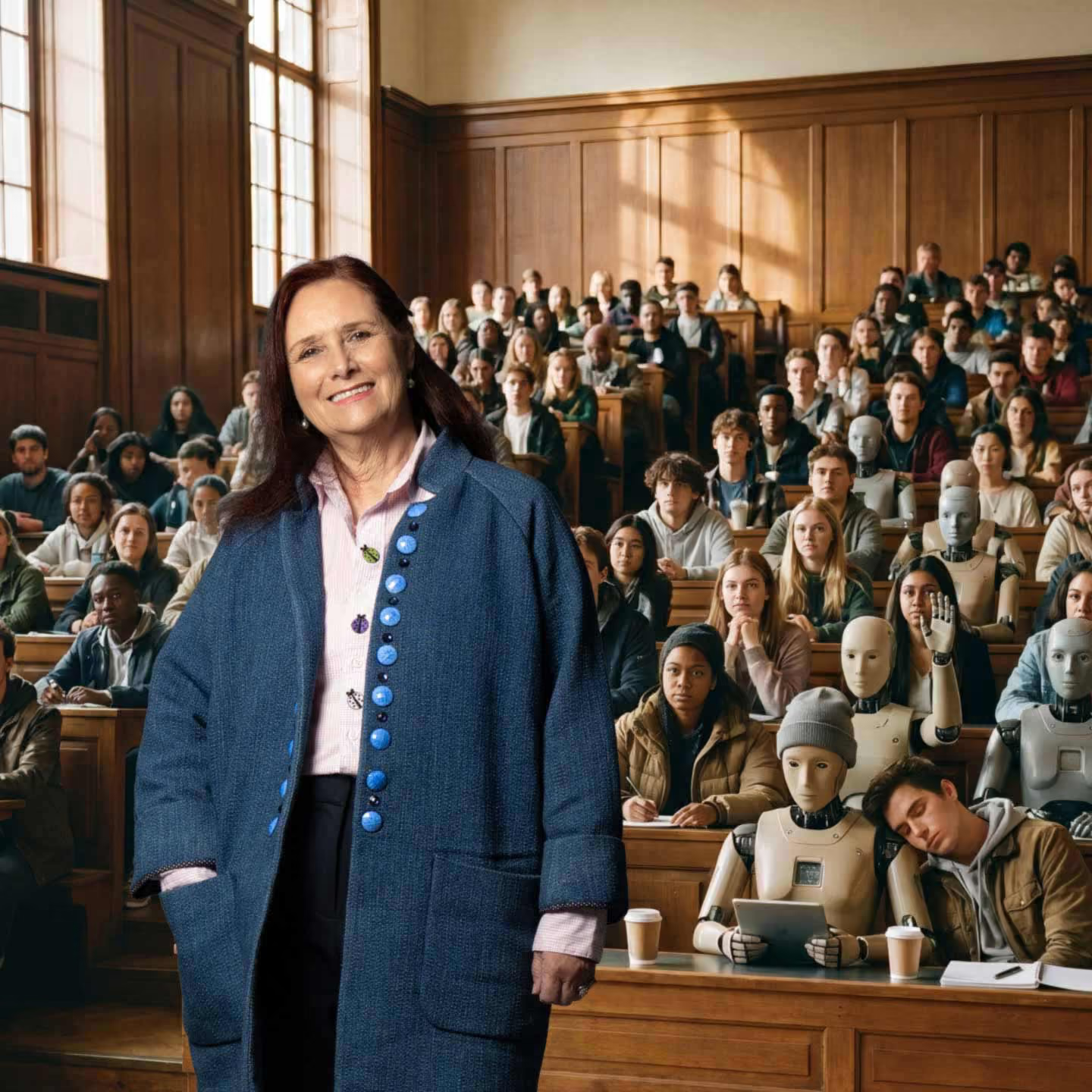
Kay Firth-Butterfield is CEO of Good Tech Advisory and served as the World Economic Forum’s inaugural head of AI from 2017 to 2023, having been appointed the world’s first chief AI ethics officer in 2014. Her focus areas are AI governance, ethics and law. She is the author of Coexisting with AI (2025).
What is your greatest hope and your greatest fear for the coming age of AI?
My greatest hope is that humans will be in charge of using AI for the benefit of humans and the planet. My greatest fear is that by the time humans understand enough about the way that AI is being used generally and signal to their government representatives that they want to be in charge, that horse will already have bolted.
What are the crucial watershed moments when leaders need to decide whether to “hire” or “fire” their AI?
It’s the same decision that you might make around a human employee. Do you tolerate mistakes and up to what level? Above that level, you would sack your employee, and the same is probably true for an AI agent. International Data Corporation expects that 20% of the largest companies in the world will be sued because of their AI agents by 2030. It’s likely that they’re right because a lot of companies are rushing to introduce AI agents.
What areas of decision-making should stay reserved for humans and not be encroached upon by AI systems?
Let me tell you about my own no-go area. I had breast cancer three years ago, and I was very happy to have as much AI-aided help as the doctor needed, because AI is really good at recognizing patterns. But when I had the surgery, I would not have wanted an AI doctor. Liability is an open question. Then my medical oncologist asked me, wouldn’t it be amazing if we used AI to help you walk you through your journey with cancer? And I said no. If I’m going to die, I want to hear it from a human, and not a machine.
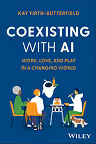

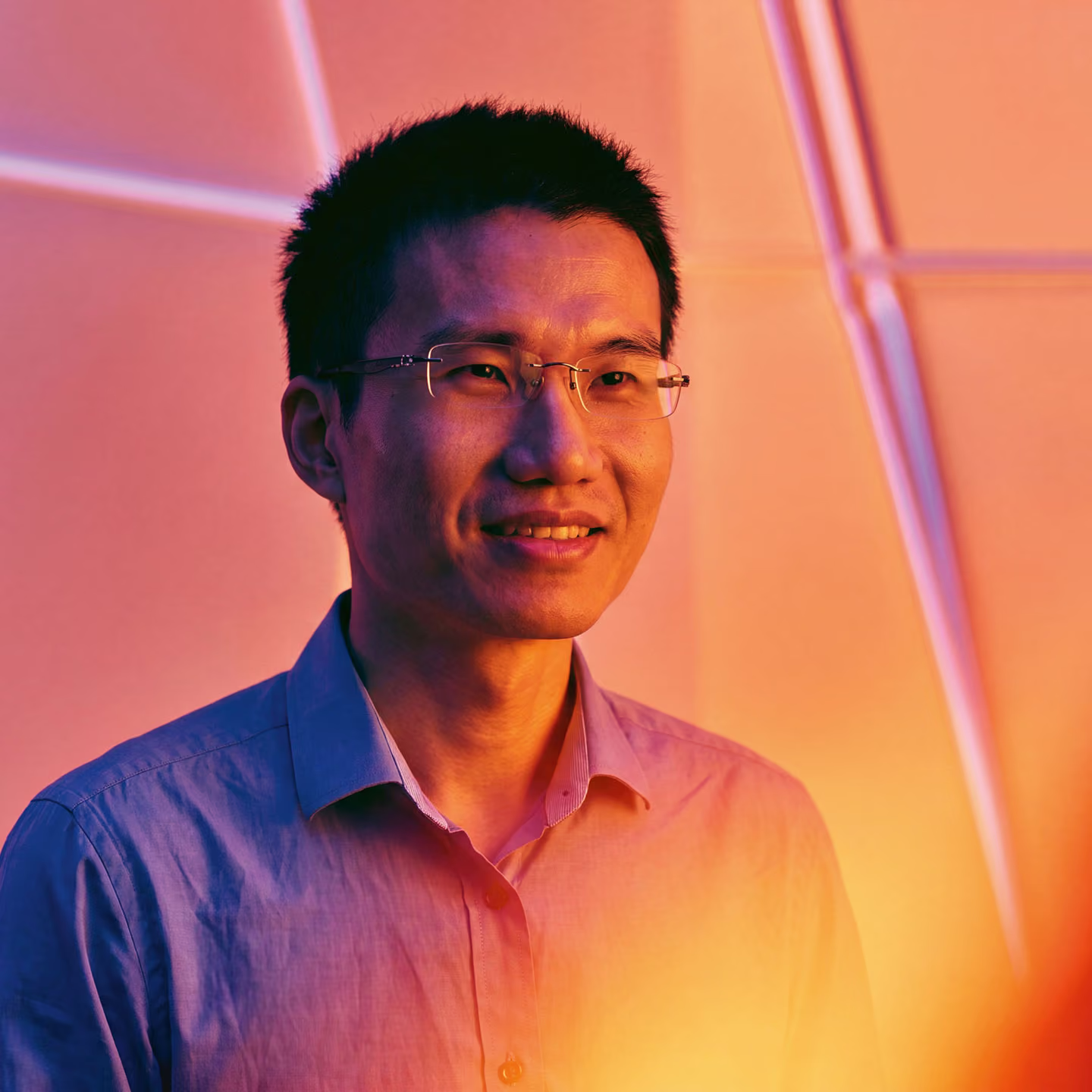
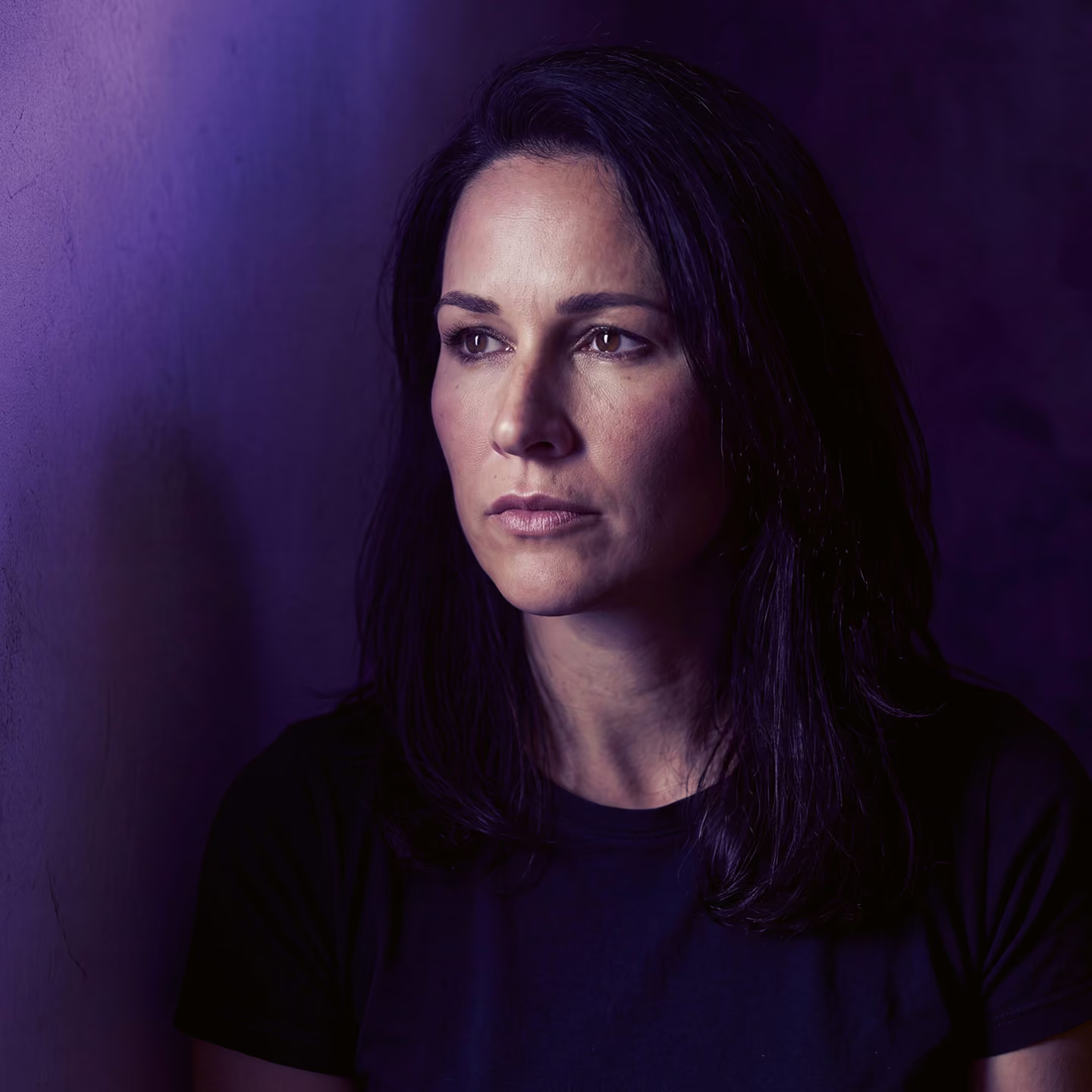
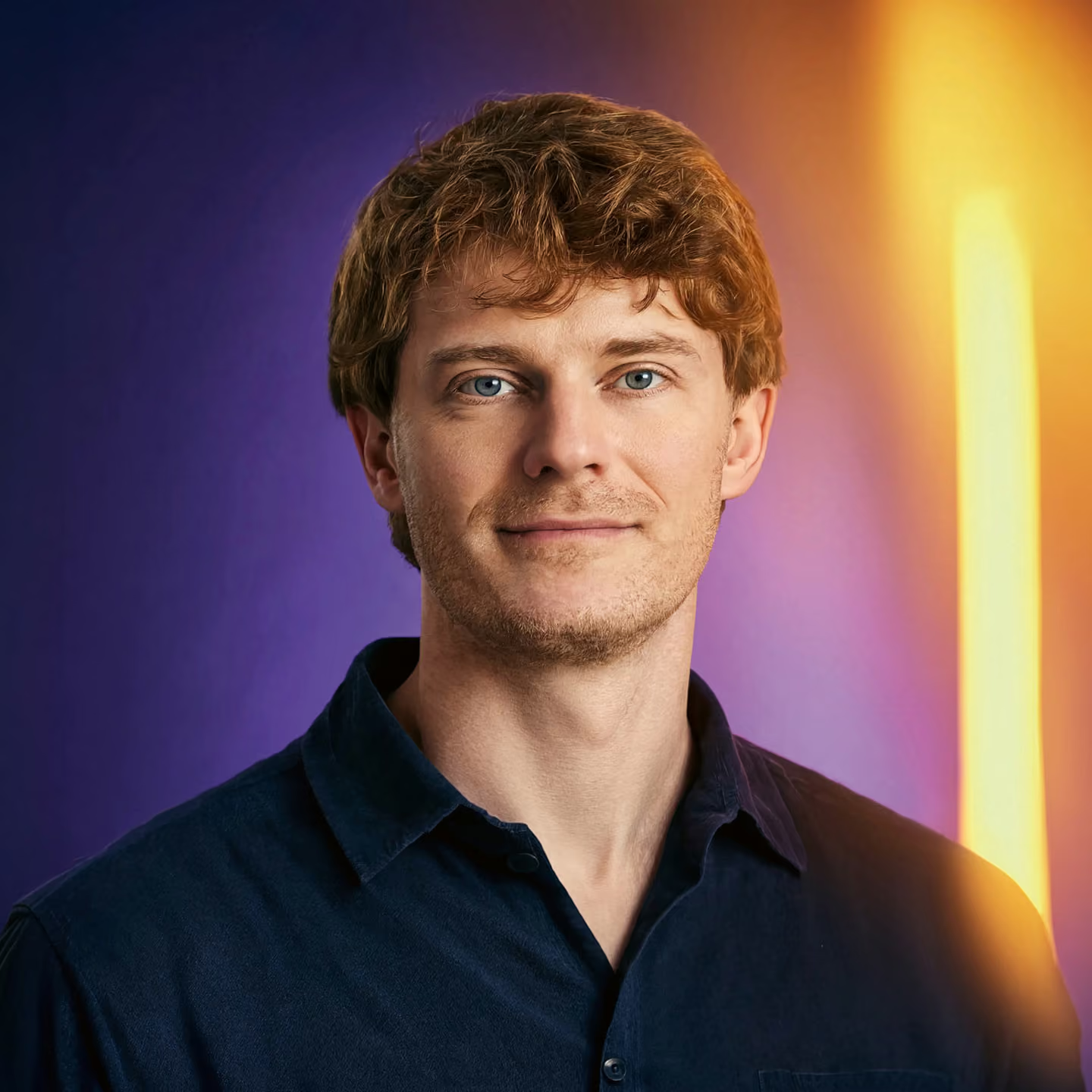
Don’t Miss: Our Next 5 AI Experts







Stay ahead of the curve!
Sign up for our newsletter and let Think:Act bring you up to speed with what is happening today and guide you on what’s happening next.







.svg)
