
How nature-based solutions are redefining climate defense
What if the most effective climate adaptation strategy isn’t concrete or steel, but forests, wetlands and reefs? Around the world, companies are beginning to treat ecosystems as vital protective assets.
Protecting your business from the risks of climate change is a challenge. It is also time-consuming. Sometimes it can take a good decade to shore up your company’s defenses – especially when the solution means you have to get nature on your side. Take Nespresso, whose single-use pods face criticism from sustainability experts. It sources a large part of its beans from the Brazilian Cerrado, located in the country’s Central Plateau. In 2013, the company commissioned an “ecosystem services review” with the International Union for Conservation of Nature which “flagged material landscape-level risks that no single actor could solve alone.”
The writing was on the wall, says Nespresso’s head of coffee sustainability Julie Reneau: “We risked near- to mid-term impacts on farmer livelihoods, municipal water availability and the stability of high-quality supply.” Nespresso swung into action and helped build an unprecedented coalition of growers, traders, roasters, researchers, NGOs and municipalities. The Cerrado Waters Consortium (Consórcio Cerrado das Águas, or CCA) began operations in 2019 and today covers more than 2,000 farms that receive assistance and funding to implement climate adaptation plans instead of racing to install their own emergency irrigation systems. “The main advantage is to act at landscape scale with a unique collaborative platform that brings together market competitors, cooperatives, producers and NGOs toward a pre-competitive goal: water,” says the consortium’s Fabiane Sebaio.
Building such an alliance was time-consuming, but the CCA has developed a “cost guide” to help farmers understand what’s at stake if they don’t act together. “We showed that after an initial increase in costs in the first few years, there was a subsequent 20% reduction in production costs and greater resilience to drought,” Sebaio says. After the first 144 farms had transitioned to more sustainable methods and more than $1 million in capital had been disbursed, she adds, they created an “exportable social technology” that can be applied to have production and conservation go hand in hand.
“We showed that after an initial increase in costs, there was a 20% reduction and greater resilience to drought.”
Such thinking and investing beyond one single company’s factory or supply chain is still more the exception. But “nature-based solutions,” as experts call them, are making inroads in many industries around the world. The underlying logic is simple: Protecting nature protects balance. In an era of escalating climate risk and record disruptions, companies have begun to rethink how ecosystems can be part of their business plan. The best and most efficient infrastructure to manage risk is the one you don’t need to build.
In 2022, the UN Environment Assembly defined nature-based solutions as “actions to protect, conserve, restore, sustainably use and manage natural or modified terrestrial, freshwater, coastal and marine ecosystems while simultaneously providing human well-being and biodiversity benefits.” That’s a lot of jargon many business leaders will not immediately write a check for, admits Giulia Carbone, an executive with the World Business Council for Sustainable Development (WBCSD), a global organization that brings together 200-plus multinationals. “Nature-based solutions are conservation action driven by a societal challenge, not a concept designed for business,” she adds. But companies can no longer ignore the risks to their operations when ecosystem services provided by nature collapse.
Floods, landslides, wildfires, drought can shut down suppliers, destroy factories, prevent employees from coming to work and even tank share prices. Yet while apprehension about the next natural disaster is rising, companies still need guidance on why it makes sense to invest in broader adaptation measures. “The business case remains difficult to articulate and investment remains inadequate,” the WBCSD admits in one of their reports on the topic. Carbone puts it more bluntly: “Building a wall or planting some trees on the roof take a year, but neither is a nature-based solution. Interventions to protect and restore nature take 10 years or longer and require collective engagement.”
Native Growth
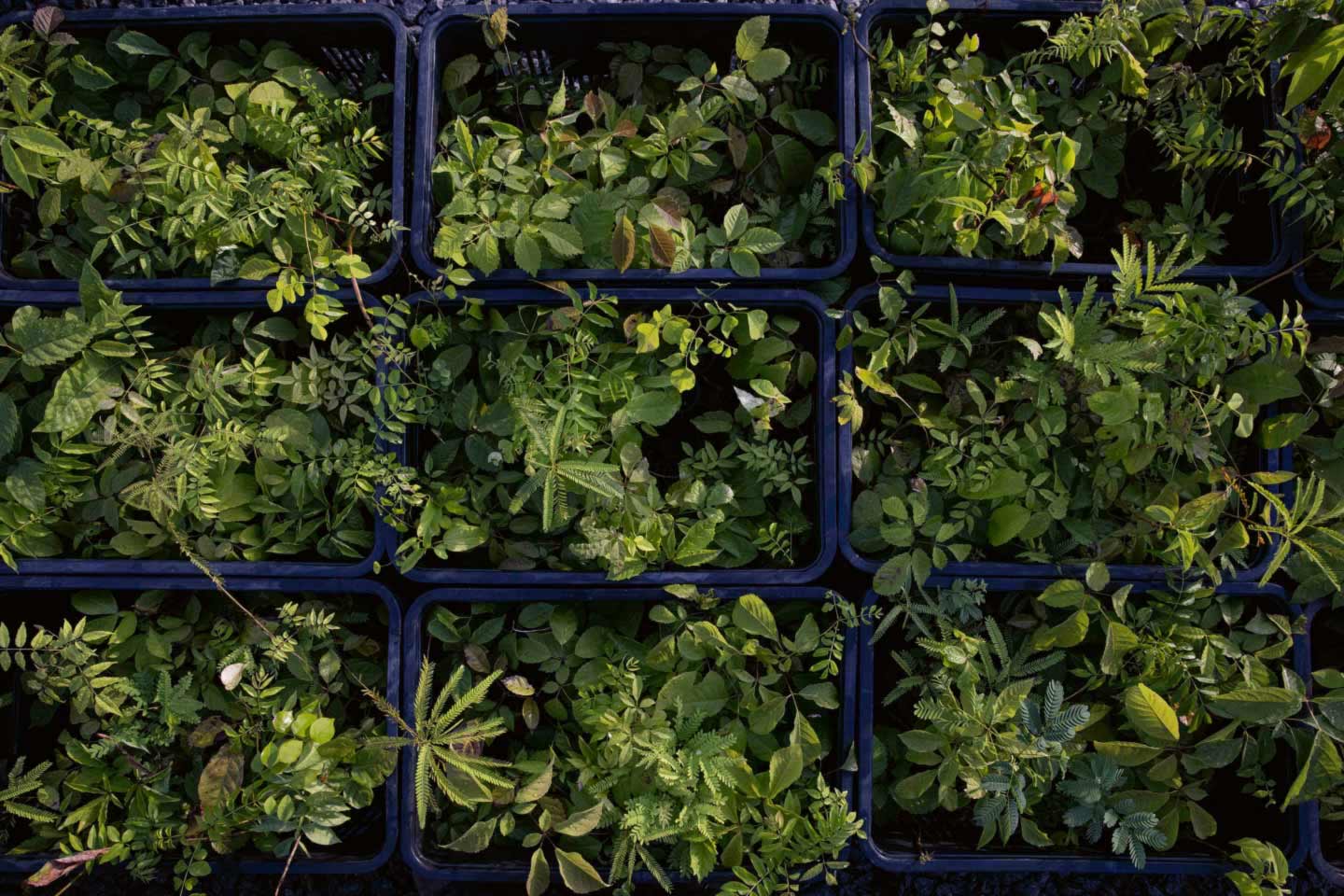
At a nursery of the Mombak project in Mãe do Rio, Brazil, the land used for the cattle ranches that ruled the Amazon for decades is now trading in something else: trees to lock away planet-warming carbon.
The alfalfa approach
A pilot at Adelaide Airport in South Australia proves that green defenses can start with a small idea and end with encouraging results.
Working for the local water authority, engineer Greg Ingleton came up with a novel idea to adapt to extreme heat at the airport with almost nine million passengers per year: plant alfalfa on four out of 200 hectares around the airfield.
It took just $200,000 to get the pilot going, and after three years, the results were encouraging. Average temperatures, which can reach well into the 40°C range, went down by 2.4 degrees, which translates into reduced energy use for cooling the terminal building and less stress on ground staff. Lower temperatures also reduce fuel use during takeoff and prevent tire bursts. What’s more, selling the alfalfa harvest produces a recurring annual profit.
After talking to other airports in hot settings such as Abu Dhabi, Riyadh, Delhi, Brisbane and Sydney, his idea was put on hold by pandemic-related travel shutdowns. Yet the engineer remains optimistic: “I am hoping it will eventually become a standard activity in many hot airports. It just makes sense. Perhaps it is too simple for people to really see the benefit.”
A proper green defense starts with identifying a company’s specific risks and priorities and then identifying all the other actors that share the same problem and hence have an interest in sharing the solution – and costs. Carbone and colleagues usually start talking to a company’s sustainability people. Next, they rope in experts from the finance, procurement and risk management functions to make sure "they understand how this can really be worth the investment."
To this day, nature-based solutions suffer from the so-called “tragedy of the commons” when pursuing individual short-term gain en masse ruins a public good. Earth provides free protections that everyone likes to use and benefit from but no one really pays for: Forests serve as carbon sinks, mangroves and wetlands protect against storm surges that would otherwise inundate or wash away factories, warehouses and office buildings, the vast oceans absorb massive amounts of humanity’s pollutants while providing food, shipping lanes and corridors for fiber-optic cables without which globalization wouldn’t exist.
Companies, it turns out, have been more or less freeriding so far. Wildfire risk is a good example. The parched landscapes of California, home to Silicon Valley, the epicenter of the tech industry and current AI boom, go up in flames much more often, affecting both companies and citizens. Yet when in 2023 environmental consultancy SWCA put together an innovative community wildfire protection plan in the area that also benefits the large tech players, funding came entirely from public grants. “Building resilience to wildfire risk is an operational imperative,” says SWCA’s Victoria Amato. “Businesses’ facilities as well as their access to energy, water and transportation networks are vulnerable to wildfire disruption.” Her organization’s big focus this year, therefore, is to “start meeting with and pitching to some of these companies on why it makes sense for them to start investing.” What could help convince them is a tool called ROSI (Return on Sustainability Investment) that the firm developed with economists at New York University’s Stern School of Business to calculate ROI on sustainability measures.
A rooted future
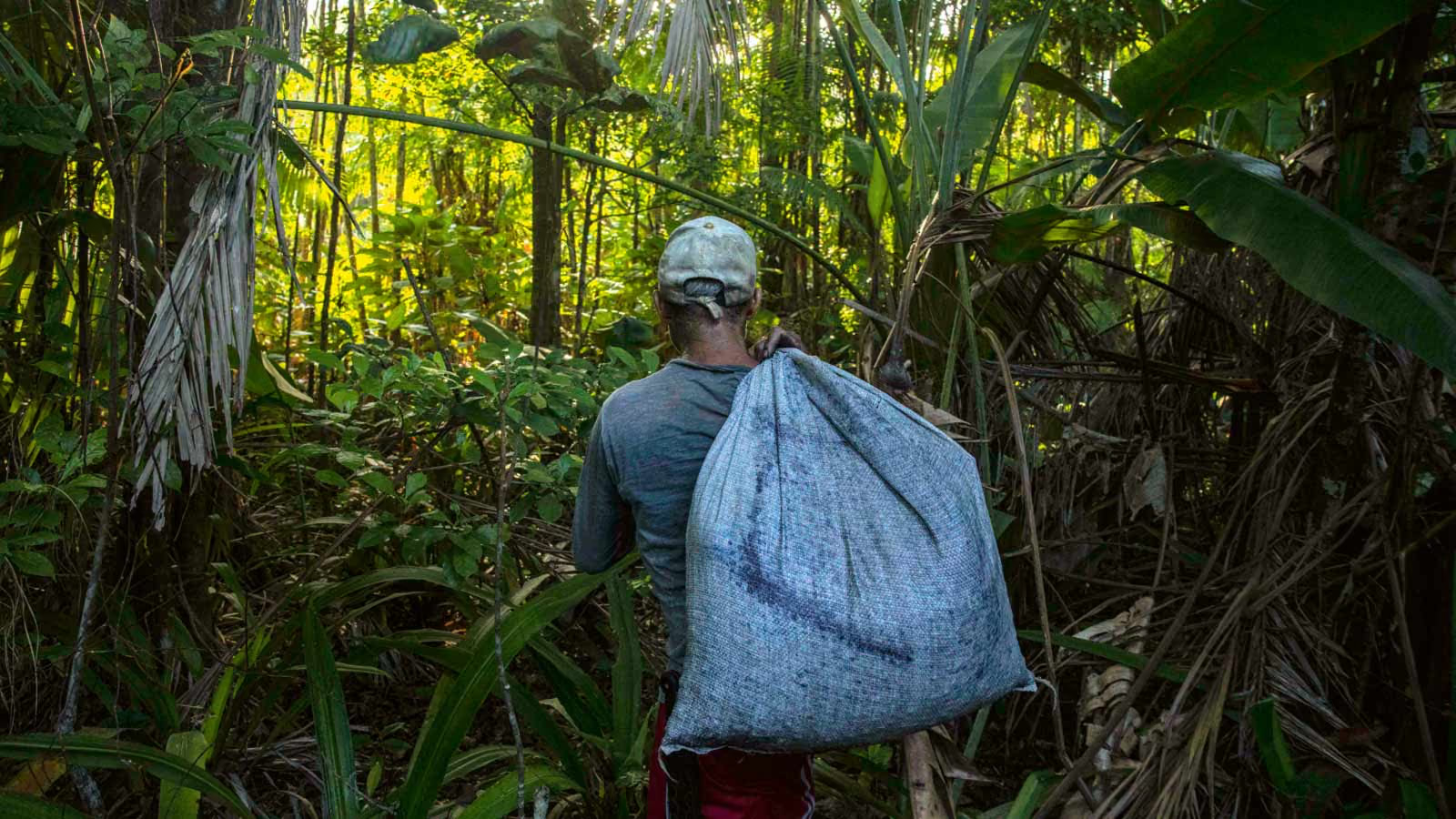
Native Amazonian tree seedlings are raised at the Mombak company nursery in Mãe do Rio, Brazil, as part of a reforestation project to sell carbon sequestration to large multinational companies involved in reducing greenhouse gas emissions.
Nine different ways green defense pays off

1. Reduce supply chain risk and strengthen supplier and regional stakeholder engagement

2. Reduce risk exposure in own operations

3. Reduce business impact on nature and biodiversity

4. Improve business performance, e.g. by improving the quality of raw materials

5. Support regulatory compliance and protect your license to operate

6. Control and reduce CAPEX and OPEX

7. Deliver direct and indirect health benefits to communities and employees

8. Decarbonize value chains through improved agricultural practices

9. Strengthen recruitment, employee engagement and brand image
In the final analysis, it comes down to showing the financial benefits to invest in coral reefs, mangroves or fishing communities in faraway places that most executives will encounter on their scuba holiday. “Nature is the biggest ally that we have as a risk hedge to invest in. It makes short- and long-term business sense,” argues Karen Sack, executive director of the Ocean Risk and Resilience Action Alliance (ORRAA). ORRAA is connecting the international finance and insurance sectors with governments, nonprofits and stakeholders from the Global South to build and introduce novel finance products. “Nature has been subsidizing our lifestyle, but we’ve been spending down that free subsidy without considering what that means. The ocean is probably the largest capital asset, and two-thirds of publicly listed companies are potentially exposed to risk from a changing ocean,” says Sack.
So far, her organization has helped develop and roll out 50 new finance and insurance products, from reef insurance issued by AXA Group and Munich Re to a new bond called T. Rowe Price Blue, which at its launch in September 2025 raised more than $200 million. “It was totally oversubscribed, so there is real interest in the space,” says Sack. The key is to get from philanthropic trials to commercially viable products that scale. “What we hear from our partners is that the lack of an investable product pipeline is holding them back.”
Over the course of four years, ORRAA has helped activate around $117 million in investments (on top of $20 million in grants), and Sack is confident it can reach its declared goal of $500 million by 2030. Another focus of the alliance are knowledge products that companies can use to better understand their risk exposure, for instance whether they should insure ships that are involved in illegal fishing.
“Nature is the biggest ally that we have as a risk hedge to invest in. It makes short- and long-term business sense.”
There are bright spots on land, too. Mombak, a Brazilian startup founded by two young tech executives, has closed record carbon removal deals with both Microsoft and Google. In early 2024, Microsoft signed an agreement to remove 1.5 million tons of CO₂ from the atmosphere through 2032 with Mombak’s Amazon rainforest restoration project. Google struck a similar pact with Mombak to remove 200,000 tons. “Both companies actively help us design, stress-test and validate what high-integrity carbon removal should look like,” says co-founder Peter Fernandez. The focus on what really works – and not greenwashing math – is deliberate. “The carbon market’s reputational damage is partly deserved,” he admits. “Early markets included projects that were poorly designed, poorly monitored and in some cases outright fraudulent.”
By working with forestry services and farmers in Brazil, the startup aims to address two problems at the same time: help tech companies balance out the environmental consequences of the voracious growth of cloud computing and AI offerings, as well as restore overfarmed, stressed lands in the Amazon. “Nature-based solutions,” says Fernandez, “belong at the core of corporate risk management and business continuity strategies.”






Stay ahead of the curve!
Sign up for our newsletter and let Think:Act bring you up to speed with what is happening today and guide you on what’s happening next.







.svg)
