

Garry Ridge on fearless leadership
You don’t have to be brilliant to be a great leader – just willing to learn. Former WD-40 Company CEO Garry Ridge explains how building a people-focused, fear-free culture helped boost employee engagement and turn the US brand into a global success.
the former CEO of a multi-billion-dollar company, Garry Ridge now refers to himself – tongue slightly in cheek – as a “PIP” – a Previously Important Person. It’s a moniker very much in keeping with the Australian’s humble, down-to-earth approach that has shaped his career.
Ridge may no longer be in the public eye, but you’ll likely recognize the brand at which he made his name: WD-40 is a product known around the world for its ability to fix anything from squeaky hinges to bicycle chains or rusty machine parts.
He led the San Diego-based company for 25 years until 2022, transforming it from a firm with limited international presence to the global operation it is now with sales in more than 170 countries and 700 employees around the world. While it is best known for its signature multi-use spray in a blue and yellow can, the WD-40 Company expanded under Ridge and now comprises a group of brands featuring a range of maintenance, specialty and cleaning products.
Key to Ridge’s success was his focus on company culture. Inspired by Aristotle, the Dalai Lama and tribal cultures around the world, he helped ensure employees at WD-40 Company feel safe, valued, happy and committed to their work. Employee engagement scores consistently reach 90% or more.
His self-effacing 2025 book, Any Dumb-Ass Can Do It, distills Ridge’s decades of experience into a plainspoken guide to finding balance and generating a widely admired company culture. In this exclusive interview, Ridge discusses the keys to great leadership, creating an engaged workforce and why “dumbassery” is a superpower.
Garry Ridge joined WD-40 Company in 1987, rising from Asia-Pacific managing director to president and CEO in 1997 – positions he held for 25 years. Ridge helped transform WD-40 into a globally admired organization with net sales of $518.8 million by the time he stepped down in 2022. By 2025, net sales had reached $603 million.
Now chairman emeritus at WD-40 Company, Ridge is also an executive coach as well as adjunct professor at the University of San Diego, where he teaches on the Executive Leadership program.
“To me, dumbassery is a superpower. The three most important words I ever learned in my life were ‘I don’t know.’”
Your recent book is called Any Dumb-Ass Can Do It. Why did you pick that title?
In Australia, ass means donkey. Now, donkeys get a bad rap – people think they’re just stubborn or slow. But here’s the truth, and it aligns with leadership: Donkeys are steady. They’re loyal. They know how to conserve energy and to get the job done. And while they may not always rush into things, that caution often keeps them safe. So, when I say any dumb-ass can do it, what I really mean is you don’t have to be brilliant to be a great leader. Because, like the donkey, leadership isn’t about showing off. It's about carrying the load, sticking with the journey and helping others get to where they need to go.
You’ve talked about the importance of “learning moments” throughout your career. How would you describe the concept and what have been your biggest ones?
I define a learning moment as a positive or negative outcome of any situation that needs to be openly and freely shared to benefit all. I didn’t know it at the time, but my first big one came when I’d just been promoted to CEO of WD-40 Company and was reading an article by the Dalai Lama. Two sentences jumped out, which would change the way I would live out the purpose of my own career. “Our prime purpose in life is to make others happy. And if we can’t make them happy, at least don’t hurt them.”

How did that affect your tenure as CEO?
When I was appointed, my mandate was to expand what was mostly a US-based product into a major global brand. First, we had to find ways to create an inspiring, emotionally compelling internal culture that could be expanded across the globe. That meant establishing an organization where people felt safe and were free to make decisions without quacking up the hierarchy somewhere around the world. We needed a culture that empowered people, where they felt like they belong, where they knew their work mattered.
There were two ideas that helped shape my formula to implement this approach. One was the quote from the Dalai Lama and the other was Aristotle’s idea that “pleasure in the job puts perfection in the work.” A crucial third part was attending the executive leadership program at the University of San Diego by Dr. Ken Blanchard.
You were already in your second year as CEO when you started that program. What motivated you?
I think it was pretty unusual for the CEO of a US public company to go back to school two years into the journey. Essentially, I wanted to confirm what I thought I knew and learn what I didn’t know. In the beginning, it was daunting – I was in my 40s and hadn’t been to school for many, many years. But it was exciting. Every month I went to class, I would learn something that I could then test in real business. That was so insightful, taking a theoretical learning and then going to see if it really worked.
Five Facts about WD-40 Company

Originally called Rocket Chemical Company, the firm was founded in 1953 as a supplier of rust-prevention solvents and degreasers for the aerospace industry.

WD-40 stands for Water Displacement, 40th formula – the name entered in the lab book by the chemist who developed the product.

The formula for WD-40 Multi-Use Product is a trade secret so protected the company never even filed for a patent. It claims only a single person knows every exact ingredient.

In 1969, former CEO John S. Barry renamed the firm WD-40 Company to match its flagship product, realizing the original “Rocket Chemical Company” moniker no longer reflected the core business.

WD-40 Multi-Use Product is sold in more than 176 countries and is reportedly found in four out of five American households.
So, what were the most effective changes you introduced at WD-40?
At the end of my two-year master’s program, I put together a model that captured what I believe were the key elements.
The first one was creating a people culture, or as I called it, a tribal culture. A place where people actually felt and were treated like they belong. I was inspired by tribal cultures all over the world throughout the centuries. We identified a range of essential components for a flourishing tribe, including learning, values, skills and celebration.
Number two was, “Do we have a clearly defined purpose in the organization?” Purpose isn’t necessarily your product, it’s, “What are you delivering?” At WD-40, I made sure everyone knew that we weren’t just in the lubrication business – we were in the memories business. We went to work every day to create positive, lasting memories for different groups of people: the consumers who used our product; our colleagues; the customers we supplied; the communities that we were given permission to live in; and even the environment that allowed us to operate.
The next one was values. We implemented a set of hierarchical values to protect people and set them free – enabled them to make decisions without fear. We also got rid of the word manager. Because our job as leaders is not to manage people, it’s to coach them. At the center of this process is a philosophy I called “Don’t mark my paper, help me get an A.”
And then finally, how do we take fear out of the organization? One of the key foundations of that was we said, we don’t make mistakes – we have learning moments. Every great invention is the result of learning. So, we said we’re going to be a learning organization, not a fear-based, anti-failure organization. Most people in organizations don’t lie; they fake and they hide. And the reason they fake and hide is because of fear. So, one of the greatest gifts we can give to organizations as leaders is to ensure that we’re creating an environment where fear is not the driver of behavior, it’s care and learning.
The Man Behind No. 40
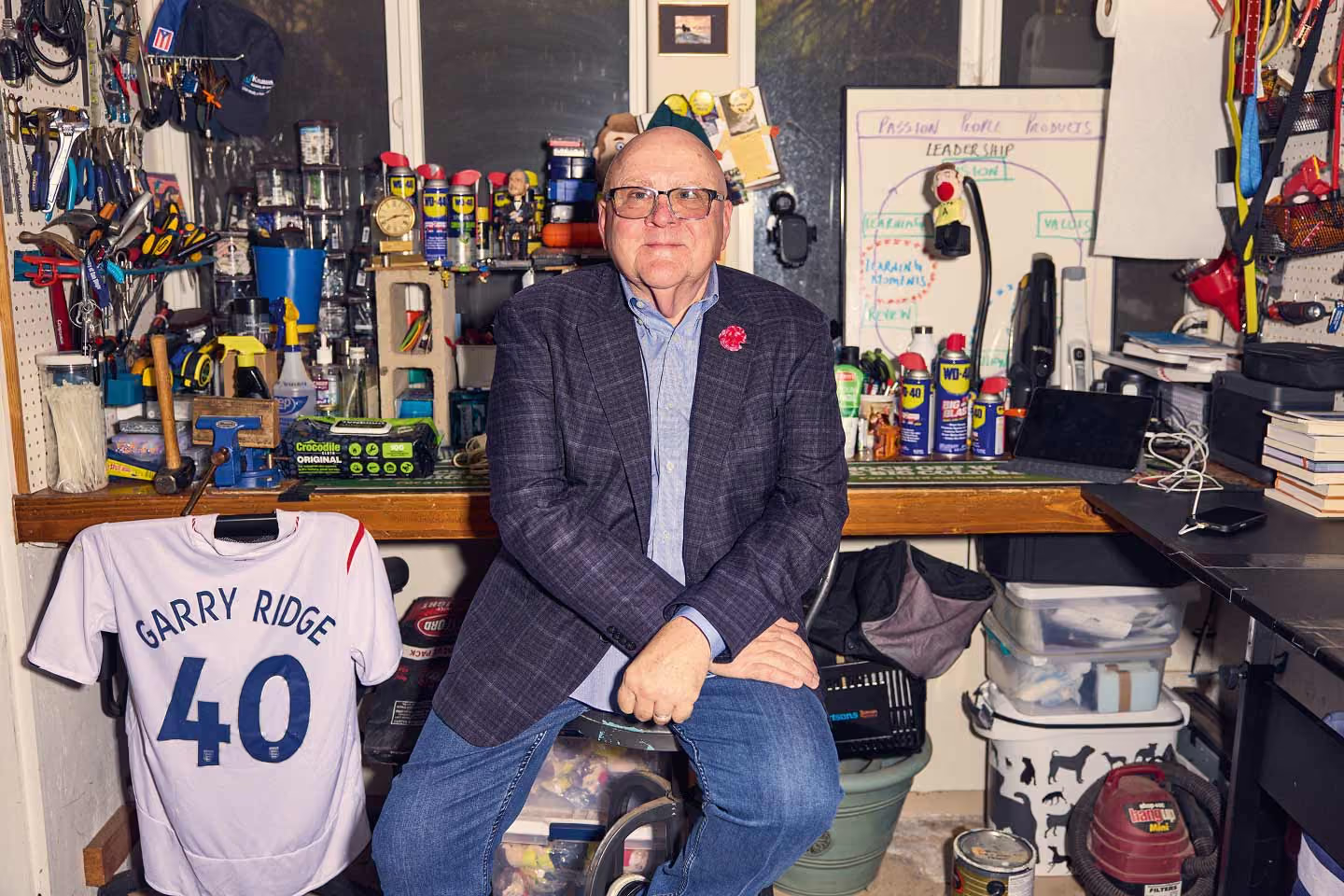
Garry Ridge, longtime CEO of WD-40 Company, in his personal workshop. The jersey beside him “Garry Ridge, No. 40” pays tribute to the iconic product that defined his career.
Was there any resistance to these changes?
When we started to implement this, back in the early 2000s, people didn’t really talk about culture too much. I think there was a feeling that having a people-focused culture was all about pizzas and parties. It’s not that at all. Great leadership is a balance between being tough-minded and tender-hearted; the genius is the “and” in the middle, knowing when you have to lean in with empathy and knowing when you have to lean in with direction.
Time was a big factor. You can’t sprinkle fairy dust on an organization to change the culture. After we started to implement the changes, people saw our employee engagement numbers start to rise. This was proven during Covid-19. Just prior to the pandemic, we had really high employee engagement numbers – over 90%. In early 2021, we did another pulse survey and the numbers had remained the same, with one exception: The number of employees responding positively to the question ‘I am excited about my place in the company’s future’ had actually gone up. So, I asked them to find out why. And this was probably the most rewarding moment in my career: People said the reason was that they felt safe. That showed to me that we were living our tribal promise. At the time, it was also the best financial year in the company’s history.
How would you describe your leadership style?
I had to learn pretty quickly how to shut up and be a better listener, to not want to micromanage. To me, dumbassery is a superpower. The three most important words I ever learned in my life were “I don’t know.” Leadership is about getting comfortable with that and surrounding yourself with people who can help you find the answers.
Is this humble style of leadership becoming more or less prevalent?
I think it’s becoming more common, but there’s still a huge void. Everybody thinks this is soft stuff, but it’s really, really hard. We’re dealing with the most complex thing in the world: human beings. If it were easy, the world wouldn’t have such despicable employee engagement numbers. According to the latest Gallup figures, global employee engagement is down at 20%. So, I think there’s a bigger awareness of it, but you have to have patience. It’s simple, but it’s not easy.









Stay ahead of the curve!
Sign up for our newsletter and let Think:Act bring you up to speed with what is happening today and guide you on what’s happening next.









.svg)
