

The business cost of extreme heat
Extreme heat is no longer a regional inconvenience but a global threat to workers and the systems that depend on them. Businesses that fail to intervene risk lives, productivity and long-term legal liability.
William Martinez was 12 years old when he joined the sugar-cane cutters in Chichigalpa, Nicaragua. In his community, men routinely worked 12-hour days under the relentless sun, with little water, no shade and no rest. What began as a way to support his family soon became a fight for survival. Friends, cousins and colleagues began falling ill. Many died from a mysterious chronic kidney disease that swept through the workforce. “We cut cane, we get sick and we die,” was a phrase that came to define an entire generation, Martinez says.
His father was among the victims, dying at 43. Before he passed away, he left his son with a short but life-altering message: “Study, so you don’t end up like me.” Martinez listened. He earned a degree in industrial engineering with a focus on occupational health. Now he seeks to protect workers around the world from the dangers of working in high temperatures. “What I saw in my community is not unique,” Martinez says. “Extreme heat does not distinguish between country, language or industry.”
That reality is becoming harder for businesses to ignore. In 2024, the world recorded its hottest year on record, with 2025 close behind. The past 11 years, from 2015 to 2025, will each rank among the warmest in the 176-year observational record, with the past three years being the hottest ever measured. Once treated as a seasonal inconvenience or a regional issue, heat has become a fundamental risk to the global economy.
At least 2.4 billion workers are now exposed to excessive heat globally, resulting in more than 22.8 million occupational injuries and nearly 19,000 deaths each year, according to a 2024 report by the International Labour Organization (ILO). The health risks are wide-ranging: heatstroke, dehydration, kidney failure, cardiovascular strain and neurological disorders. These conditions undermine long-term health, household income and economic security. Mental health impacts such as stress, exhaustion and anxiety are frequently overlooked. To compound the issues, heat is a “silent killer,” explains Radhika Khosla, professor at the University of Oxford’s Smith School of Enterprise and the Environment and an expert in heat and cooling. “Its chronic effects and impact on productivity are often attributed to other causes, allowing employers to underestimate the scale of the threat.”
Around the world, workplace heat exposure is attracting growing attention, from 55°C warehouses and boiling building sites to non-air-conditioned delivery vehicles, where the mercury can touch 50°C. Not only is this extremely dangerous for workers, it also represents a reputational risk for businesses. In addition, the burden of heat exposure falls disproportionately on the world’s most vulnerable workers. Agriculture, construction, utilities, logistics and manufacturing – sectors that underpin global supply chains – rely heavily on labor in hot and often poorly regulated environments. A new joint report from the Food and Agriculture Organization and World Meteorological Organization says agricultural workers are 35 times more likely to die from occupational heat exposure than all workers combined in other sectors.
Andreas Flouris, professor of physiology at the University of Thessaly, Greece, and co-author of the 2024 ILO report, argues that this imbalance is “not just a moral failure, but a profound economic and social challenge that threatens global stability.” Workers in low-income regions and those laboring outdoors or in poorly cooled indoor settings bear the heaviest burden, while being least equipped to adapt. The result is a widening divide between workers protected by climate-controlled environments and regulation and essential laborers who must work through life-threatening heat. “If we allow this gap to widen, we risk catastrophic consequences,” Flouris states: “mass health crises, soaring health care costs, reduced long-term productivity and ultimately, a breakdown in the very supply chains and social contracts built on the labor of the unprotected.” There remains a widespread assumption that extreme heat is primarily a problem for traditionally hot regions of the world. That assumption is dangerously misplaced, says Radhika Khosla. “In fact, the lack of familiarity with extreme heat in regions like Northern Europe means businesses, homes, cities and supply chains are not built to withstand it. And that’s going to make the impacts of increasing heat waves all the more dangerous for countries that are used to cooler temperatures.”
Khosla cites research she and her Oxford University colleagues conducted in 2023, which showed countries including Norway, the UK and Switzerland are “dangerously underprepared” for rising temperatures. According to the ILO, Europe and Central Asia experienced a 17.3% increase in excessive heat exposure between 2000 and 2020 – almost double the global average.
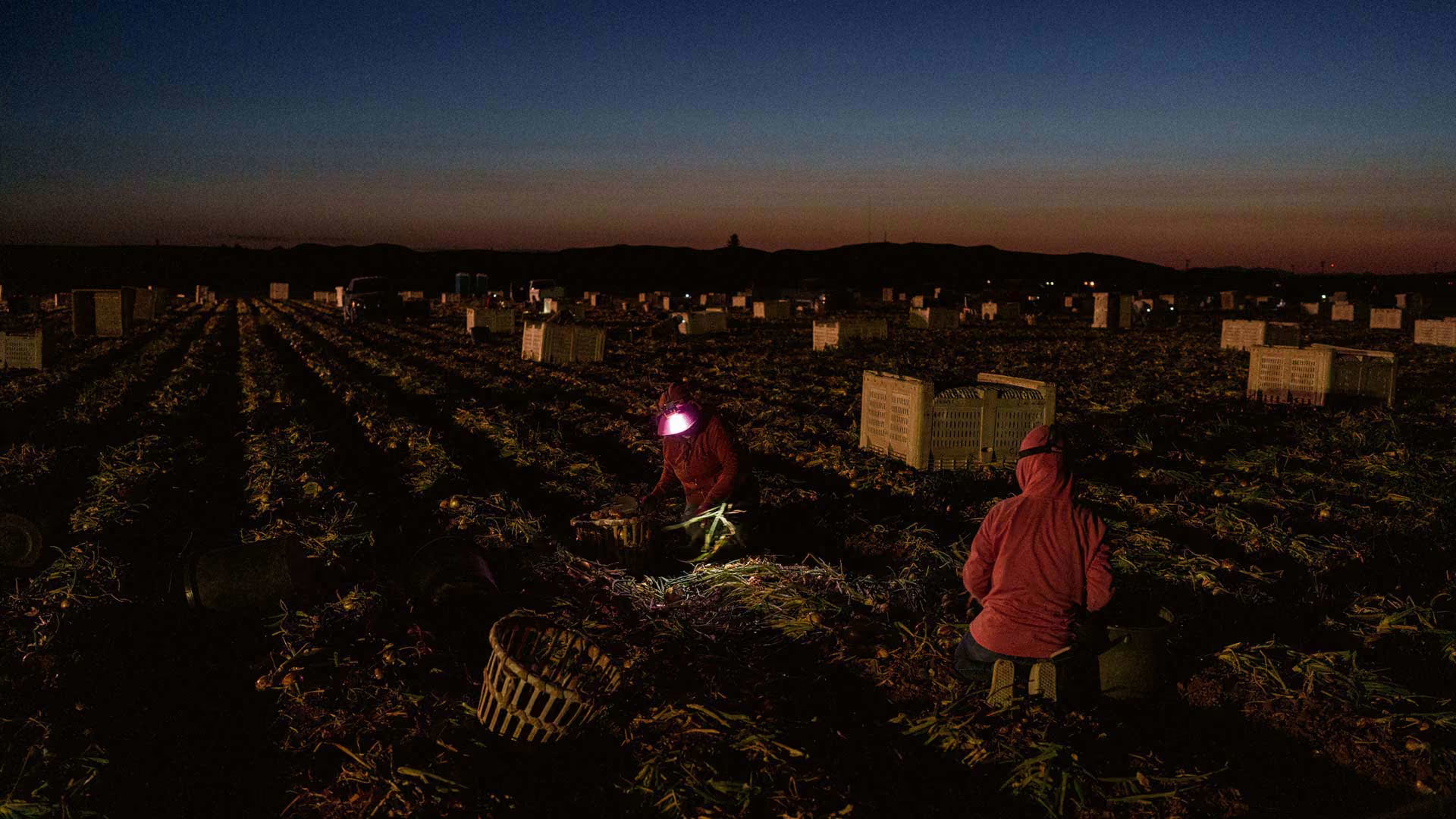
Just before dawn
With onion harvests typically taking place between late May and August, workers in the region surrounding Salem, New Mexico, can expect daytime highs of up to 35°C. The overnight lows of 16°C offer far more comfortable conditions.
“Heat’s chronic effects and impact on productivity are often attributed to other causes, allowing employers to underestimate the scale of the threat.”
The economic consequences of rising heat extend well beyond worker health. Higher temperatures strain water supplies, threaten power infrastructure and disrupt logistics and production. Financial services firm Moody’s estimates that heat waves already cost the global economy roughly 1% of GDP each year. At the organizational level, the losses are immediate and measurable. Flouris’ research shows that productivity drops by around 2.2% for every degree Celsius above 18°C. Across large workforces and complex operations, those losses compound rapidly. The ILO estimates that implementing occupational safety and health measures to prevent heat-related injuries could save more than $361 billion globally.
Despite this, action has been slow. Flouris argues that businesses must reframe the issue, shifting from asking what it costs to protect workers to understanding what it costs not to. The most effective interventions are often simple: structured work-rest cycles, access to shade and clean drinking water, acclimatization programs and adjusting work schedules to cooler hours of the day. These measures do more than protect health; they directly improve output, reduce errors and stabilize operations. “In this sense, heat protection is not an expense but an optimization of human capital,” Flouris says.
Jason Glaser knows just how effective these interventions can be. He is the CEO of La Isla Network, an organization dedicated to ending heat-related illnesses among workers worldwide, as well as a colleague of William Martinez. Glaser says a multiyear program by La Isla Network at a Nicaraguan sugar mill that improved rest, shade and hydration led to a series of impressive results, including: a 94% reduction in cases of acute kidney injury linked to excessive heat, eliminated fatal heatstroke cases, increased productivity by 10% to 20% and generated a positive return on investment of 22% through lower absenteeism, reduced accidents and decreased staff turnover.
Glaser hopes evidence such as this will lead to increased action among policymakers and businesses. “Organizational buy-in remains a major obstacle,” he says. “Without alignment from senior leadership down to front-line supervisors, even well-designed interventions can fail.”
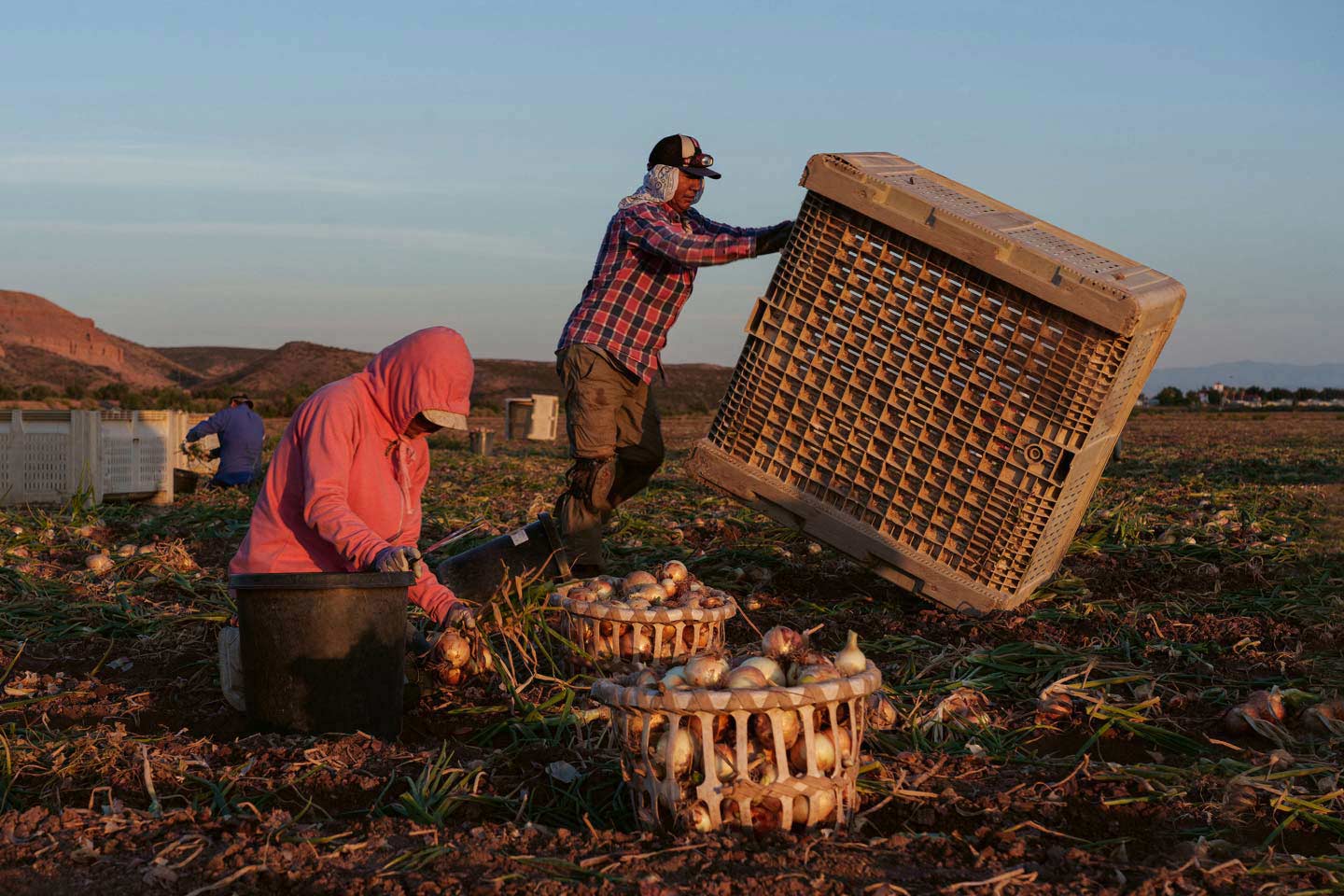
The first light of day
After working all night to fill up crates with onions for $17 each, dawn signals the final working hours for many New Mexico farm workers, who will resume work when temperatures fall.
On a macro level, improving heat resilience also requires a broader rethink of how buildings and cities are designed. “The trend for tall office buildings made of glass, which act as greenhouses trapping in heat and requiring huge amounts of air conditioning, is particularly unsustainable,” says Khosla. Becci Taylor, director at global engineering and design firm Arup and a specialist in decarbonization and sustainable building design, argues that the priority must be reducing heat gain in the first place. “Measures include external shading like awnings and shutters, reflective surfaces, better ventilation, green roofs and light-colored façades. Retrofit policy needs to integrate climate adaptation and energy efficiency instead of running on separate tracks,” she says, “while heat resilience should be integrated with low-carbon and nature-based solutions as part of wider climate adaptation.”
Roofs are a great example, Taylor says. “They typically transmit heat into buildings in summer and lose heat in winter, but this can be reduced by making them reflective and better insulated. Green roofs support biodiversity and cool in summer, blue roofs manage stormwater and photovoltaic roofs generate power while reducing heat transmission.” In New York City, Arup coated more than 500,000 square meters of rooftops with reflective materials, lowering indoor temperatures by up to 30% during heat waves.
Khosla shares this view, emphasizing the importance of passive cooling techniques such as natural ventilation, shade, vegetation and ceiling fans – approaches that have been used for centuries in hotter climates. Where air conditioning is unavoidable, she argues, businesses should invest in the most efficient systems available and ensure they are powered by increasingly decarbonized energy grids. “Otherwise, companies risk locking themselves into a vicious cycle in which fossil fuels are burned to keep buildings cool, emissions rise and heat stress intensifies further.”
“Heat stress leads to lost working hours, catastrophic injuries, high employee turnover and long-term legal liability. Ignoring this is simply bad business”
Five ways businesses can reduce worker heat stress

Shift physically demanding tasks to cooler hours, build in mandatory work–rest cycles and slow output expectations during periods of extreme heat. Productivity losses due to heat will run far higher than the cost of flexible scheduling.

Prioritize shade, airflow, hydration and recovery zones close to where work happens. Simple interventions such as shaded rest areas, cool drinking water, fans, misting or cooling vests can reduce heat strain faster than relying solely on air conditioning.

Closely track heat risk using real-time weather data, the wet-bulb globe temperature and, where appropriate, wearable sensors. Trigger automatic safety responses like extra breaks, task changes or stop-work thresholds before workers show symptoms.

Reduce heat gain through passive design: external shading, reflective roofs and façades, natural ventilation, green roofs and lighter materials. Buildings that trap heat increase risk, energy costs and downtime during heat waves.
.svg)
Heat protection fails without buy in from the top. Clear policies, supervisor training and accountability at board and management level turn heat safety from a seasonal concern into a core operational standard.
Heat resilience increasingly shapes decisions far beyond the workplace, too. Local governments in Los Angeles, Melbourne, Miami, Athens and Freetown have appointed chief heat officers to mitigate the effects of rising temperatures on inhabitants, businesses and critical infrastructure. Heat waves can trigger rolling blackouts and water shortages, which in turn can disrupt operations across entire regions. Data centers, which underpin the digital economy, are particularly vulnerable. In 2022, summer heat waves in the UK and United States forced facilities offline, disrupting cloud-based services and the businesses that rely on them. One recent report states rising global temperatures pose an increasing risk to the resilience of well over half of the world’s top 100 data center hubs.
For many organizations, though, it’s the effects of rising heat risk on their most valuable asset that remain the core focus. “Protecting your workers from heat is a mandatory pillar of a sustainable, profitable and resilient business model,” says Andreas Flouris. “The climate crisis has turned the thermal environment into a direct, measurable input of production. Heat stress leads to lost working hours, catastrophic injuries, high employee turnover and long-term legal liability. Ignoring this is simply bad business.”
For many organizations, though, it’s the effects of rising heat risk on their most valuable asset that remain the core focus. “Protecting your workers from heat is a mandatory pillar of a sustainable, profitable and resilient business model,” says Andreas Flouris. “The climate crisis has turned the thermal environment into a direct, measurable input of production. Heat stress leads to lost working hours, catastrophic injuries, high employee turnover and long-term legal liability. Ignoring this is simply badbusiness.”







Stay ahead of the curve!
Sign up for our newsletter and let Think:Act bring you up to speed with what is happening today and guide you on what’s happening next.









.svg)
