

Linda Hill on the ABCs of innovation
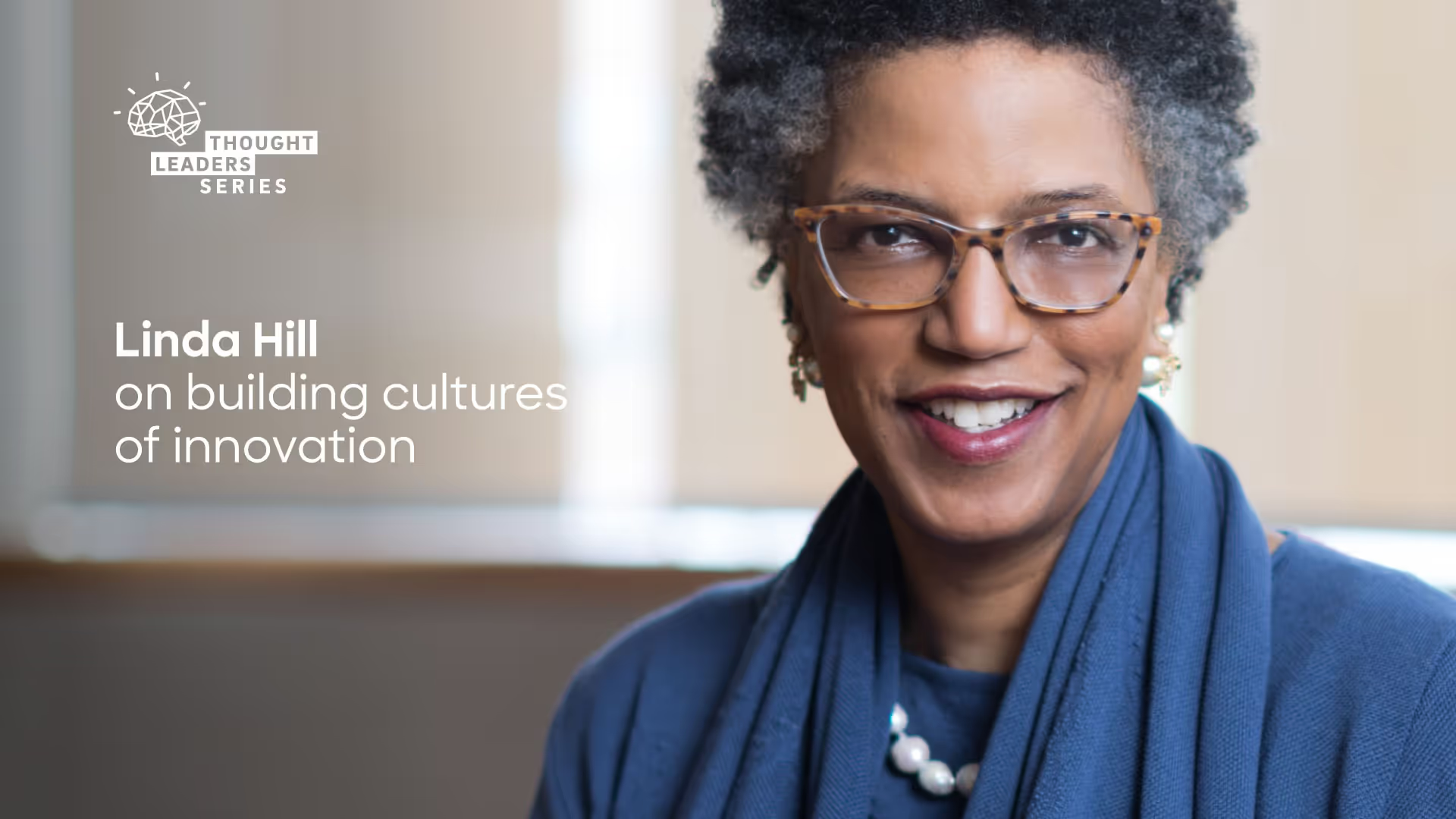
Linda Hill has analyzed innovation in business for decades. In her latest book, Genius at Scale, she introduces the three key roles that help advance new ideas across organizations: the architect, the bridger and the catalyst.
You write about getting everyone in an organization to innovate. What does it take to democratize innovation in an organization without creating chaos?
You have to unleash the diverse slices of genius in your organization because you rarely get innovation without people with different perspectives collaborating. You’ll have conflict, because people don’t think the same way. You will get chaos if you, as a leader, are not comfortable managing that conflict. Leaders have to develop the capacity to work across difference.
As a leader, if you think you have the right answer, you may think that you’re supposed to pick, as opposed to bringing our different slices of genius together and putting them in a new combination that actually will allow us to innovate. Many leaders discover that people didn’t agree, even though they were nodding. Afterwards they’re not willing to implement whatever was decided. Employees may not push back verbally, but they just don’t do it. Given how competitive business is, as a leader you need to learn how to work with top talents, and help unleash and leverage them. To keep it from becoming chaotic, you have to be clear about your purpose. Purpose makes us willing to work through differences.

best practice builder
Linda Hill is a professor of business administration at Harvard Business School and faculty chair of the Leadership Initiative. She has authored or co-authored numerous articles and books on leadership, including Collective Genius and Being the Boss. She has been shortlisted for the 2025 Thinkers50 Innovation Award alongside the co-authors of her latest book, Genius at Scale.
How can leaders make others want to innovate, especially when they identify their jobs with a certain mandate and innovating means going beyond that?
We’ve studied corporate accelerators and innovation labs. When you tell people the innovators are in that center of excellence and they’re the executors, you get a problem. You want everyone to think they have a role to play in innovation. So thatʼs the first thing: how you describe people’s jobs and what you allow them to do. Purpose is part of it too. It makes us say: “If this means that we can make a difference to our consumers, deal with a pain point, I feel good about that. It links into my identity.” Next, we need to have shared values, so I can predict how you think about things. When you build a culture, you are making the world somewhat more predictable for people in terms of how others are going to behave and they feel psychologically safe. Unless people feel safe, they wonʼt do the kind of work necessary for an organization to thrive, which is being adaptable and agile.
How is the idea of a good leader evolving, especially in today’s environment?
We spent time with large, successful incumbents, meeting leaders who were trying to make transformations. Many companies recognized they didn’t have the internal capabilities and were partnering with other organizations. A lot of that was driven by the need to get digital assets, digital talent. It became very clear that big companies were struggling to scale it. Companies working with other companies or government need leaders who know how to co-create across organizational boundaries – many organizations are still quite siloed. When you see something like Microsoft-ChatGPT, you need leaders up and down the organization who can co-create with some group very different from them. Otherwise, you’re not going to build those ChatGPT capabilities into the products of Microsoft.
It is not enough to “architect” an organization to have the culture and capabilities necessary to routinely innovate. You have to be a “bridger” and a “catalyst” as well to innovate at scale with any speed. Scale and speed really matter in today’s environment. Speed in particular because of how fast the world is moving. As a bridger, you need to be able to co-create across organizational boundaries. Finally, the catalyst role is becoming ever more important, particularly with sustainability. Look at Renault trying to do a software car or electric vehicles. Renault’s CEO wrote a letter to EU citizens saying, essentially: “For us to really meet our sustainability goals in the region and build competitive businesses we need to come together in the private sector, the public sector, communities, etc., to figure out how to build an ecosystem supportive of electric vehicles. If we don’t have charging stations and smart grids, we don’t have this.” That requires multiparty coalitions, private, public, etc. Leaders are thinking about the system where they sit and making sure that whole system is able to operate.
During Covid-19, the whole world became much more aware of how interdependent we all are. No one business on its own could survive. The biotech companies in Boston came together to create their own testing sites so that people could go to work and be together. They didn’t wait for someone else to do it. You saw private-private and private-public coalitions building to meet needs. The hospitals had to work together. So you have this recognition that we’re in an ecosystem. Business leaders understand we need those bridgers and catalysts to break down those silos.
“We need bridgers and catalysts to break down silos and build ecosystems.”


Rethink the role of formal authority
Successful innovation needs leadership, but that may not look like you expect. To take an idea and grow it at scale, try fostering an environment that embraces the spirit of co-creation. After all, you can’t tell people to innovate – you can only invite them.
Do leaders have to play all three roles together or do they get other people to handle these? What are some of the examples you've come across?
Ajay Banga at Mastercard (now head of the World Bank) played all three roles in different ways at different times, although mostly he was the architect trying to move culture and capabilities. He did enlist bridgers to play those bridging and catalyst roles. He played a lot of those catalyst roles.
The head of the Cleveland Clinic Abu Dhabi had to work very closely with their partner, the sovereign wealth fund of Abu Dhabi, colleagues back in the US, local medical centers and also regulators. He came from the US to Abu Dhabi. So he had a lot of contextual intelligence to learn. One of his younger, less experienced Emirati managers volunteered to be the lead on managing relationships with other local medical centers because he had the contextual intelligence – he was of the community. Other people volunteered to do a whole range of different activities or were appointed. They took advantage of their diversity, 80 nationalities. The architects were also bridgers. Senior people get together and do the contracting, the governance, etc. But they don’t necessarily take the time to build the relationships that are going to be required if we’re truly going to do innovation at scale together, and we come from very different organizations. So these leaders are all quite sensitive to the quality of the relationships.
Can you be good at all three roles – architects, bridgers and catalysts?
To be good at all three, but particularly as a catalyst and a bridger, you not only have to be a strategic thinker, but also a systemic thinker. A lot of leaders know how to be strategic thinkers, but they don’t necessarily know how the dots are connected. Large-scale system change is a different animal. I suspect that there are people who can be architects and bridgers who are not necessarily going to be very skilled catalysts.
“Leaders have to be able to read the tea leaves, but have people who are adaptive and willing to learn.”
The ABCs of innovation


A lot of what you’re telling me is also about being comfortable beyond the boundaries of our organizations: dealing with contexts, processes and people. How do these leaders navigate them?
They understand the connections: who’s connected to whom, who the key stakeholders are, why these stakeholders behave the way they do and how to change some of those conditions so they might think about doing things differently. They have a systemic view.
You have to understand how things work, and who’s working together, before you can make a move. The way you do Cleveland Clinic in Cleveland is different than the way you do it in Abu Dhabi. Too often leaders think they know best practice and can apply it. No. Best practice always has to be adapted. The first thing that you see about these leaders is that they know they need to develop contextual intelligence. They go in with an “I don’t know the answer” mindset. They also know they have to build teams that are collaborative and become more comfortable experimenting and learning together.
Inevitably, all the people who lead digital transformation say it’s about the people and the culture, not so much the technology. These leaders work very hard at getting the metrics and the structures right, but they also know that they are using themselves as instruments to try to get something done, and they’re role modeling the behavior they expect. So they’re collaborative, they’re experimental, they’re learners, they’re using data and those tools themselves. There’s no magic to it, and it does take time to change. But the leaders we’re studying are proactive. They’re moving even when they’re “successful” because they know the time frame of success is limited.
It’s a really hard time to be a leader. Scenario planning is just one piece of it. Fundamentally, in the end, they have to be able to read the tea leaves, anticipate as much as they can, but have people who are adaptive and willing to learn. One of the characteristics of an effective leader that keeps coming up is curiosity. You’ve got to be adaptive, curious and prepared to help your people learn.

More from this edition




Stay ahead of the curve!
Sign up for our newsletter and let Think:Act bring you up to speed with what is happening today and guide you on what’s happening next.
