
How digital twins help companies predict the unpredictable
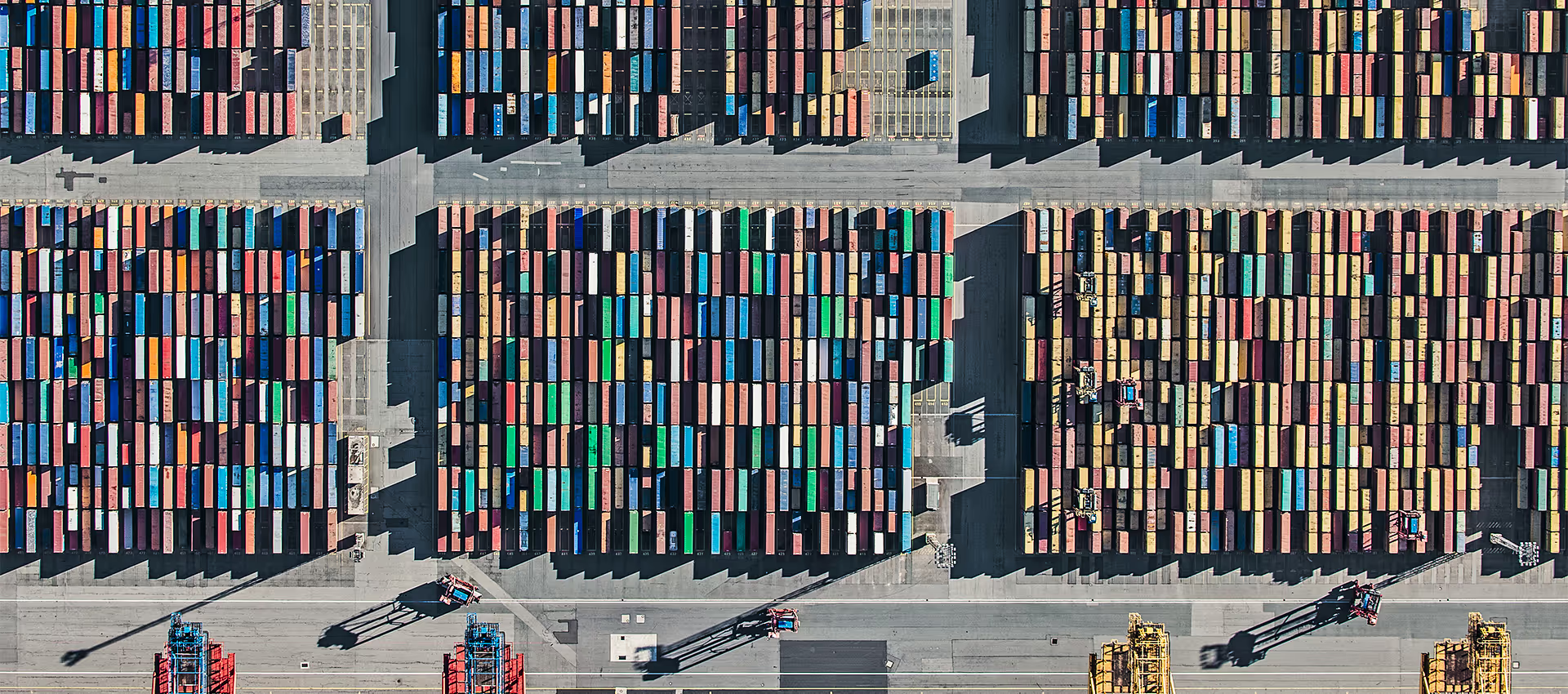
In today’s climate of disruption, logistics is as much about managing chaos as moving goods. Digital twins promise foresight and control, enabling firms to run “what ifs”, reduce risk and unlock efficiency at scale.

from meteorology (and Chaos Theory), we know the butterfly effect: The flap of a butterfly’s wing in Brazil can be the cause of a tornado in Texas. Sometimes, a system just swallows the change that happens and nothing happens at all: That’s what we call resilience. And then sometimes, it’s up for something completely different – a tipping point, a chain reaction, a disruption or just chaos.
Along the stretching and winding paths of the value chain that are called logistics, there are lots of flaps, changes and disturbances. Some of them can be planned, some just happen, some can be prevented and some can also be created to improve the overall outcome. Yes, of course you can even try to delay a delivery to the client. Because you have to be just in time (too early is often as expensive as too late), or because something happens while you’re already on the road take the sometimes surprising movements of tariffs in trade with the US.
Whatever you are moving, you’re also taking a risk: The better you take care of them, the better for your client ... and for your balance sheet. So knowing the “what if” is a key success factor in the logistics industry. And digital twin technology is one of the key knowledge tools for that task. You don’t just move your real trucks on real roads and your real ships on real oceans – you also have all of them digitally in your cloud. They move just like the real objects, but they also track their future movements: Think navigation with Google Maps, though not just with your own car, but with the whole Maersk or FedEx fleet at the same time.
And this digital twin technology allows you not only to look at one probable path, but also to play through whatever “what if” scenarios you please. “The advantages of a digital twin lie in improved decision-making, the optimization of resource usage and the ability to test future scenarios in advance,” says Björn Krämer of the Fraunhofer Institute for Material Flow and Logistics (IML). The Dortmund-based institute offers to map logistics companies’ physical processes with digital twins. “Warehousing, transport management and production logistics can be controlled more efficiently, reducing costs and identifying bottlenecks at an early stage,” Krämer says.
The technology has already left the fringes of the industry and moved into the center. And in the world of logistics, you can’t be much more central than FedEx, the global parcel giant from Memphis, Tennessee, with $88 billion revenues, half a million employees, moving some $2 trillion of value per year. “We built a digital twin of FedEx over the last five years,” CEO Raj Subramaniam said in a video interview with Yahoo Finance in May 2025. Its main target: expecting the unexpected. The logistical chaos of the Covid-19 pandemic, Subramaniam said, provided lessons that helped “prepare FedEx for this world where disruption seems to be the norm.”
How much digital twin technology could potentially reduce operational costs according to a 2024 investigation.
Source: World Journal of Advanced Research and Reviews
“Logistics can be controlled more efficiently, reducing costs and identifying bottlenecks at an EARLY stage.”

The disruptions that companies worldwide are facing are very, very different from the ones caused by the coronavirus in 2020-21, but they are also tough and challenging. Logistics giants like FedEx are not only in the center of their own industry, but also move to more central stages in the whole business world, its CEO has noticed: “While nobody cared about supply chains before the pandemic, now supply chains are part of every boardroom conversation.” Lately, these conversations have been mainly about Trump and tariffs. But with its digital twins, FedEx can walk the talk, Subramanian says: “Now, as the complexity of all these tariffs and flows becomes more ‘frictionful,’ the need for a platform like ours becomes ever more meaningful.”
However not all players in the logistics industry are moving at the same speed to implement digital twin solutions. In a very traditional industry, with lots of really expensive assets and real drivers handling them, there are ... well ... some question marks about AI reliability. As one longtime logistics executive puts it: “Whom do you trust when you make a decision like rerouting – the AI-powered digital twin, or your own experience, based on decades of doing business?”
FedEx CEO Subramaniam doubts that former experiences are that helpful in the “new normal” of supply chain chaos: “Prior to this, the need of the hour was basic algebra. Now the need of the hour is advanced calculus.” The Danish logistics giant Maersk, on the other hand, doubts that digital twins are already a feasible solution for today’s logistic challenges and gives a rather reserved outlook: “The trend remains in its early adoption phase with cautious business engagement.”
The more a company is interacting with other players along the supply chain, the lower their actual incentive to invest short-term in digital twin technology. As long as only some players in the industry implement digital twins, you can build as much of your own “what if” scenarios as you like, but may still fail if other links in the supply chain are not aligned. If the digital twin simulations – for example, a container ship – shall bear fruit, they should be coordinated with the digital twins of the respective container terminals, and their digital twins should coordinate with the digital twins of cargo trains and trucks all along the way to the final receiver of a cargo. And, of course, this final link of the chain should also be in the loop – because in the end it is the one who pays for the whole process. That’s quite a lot of “shoulds”…
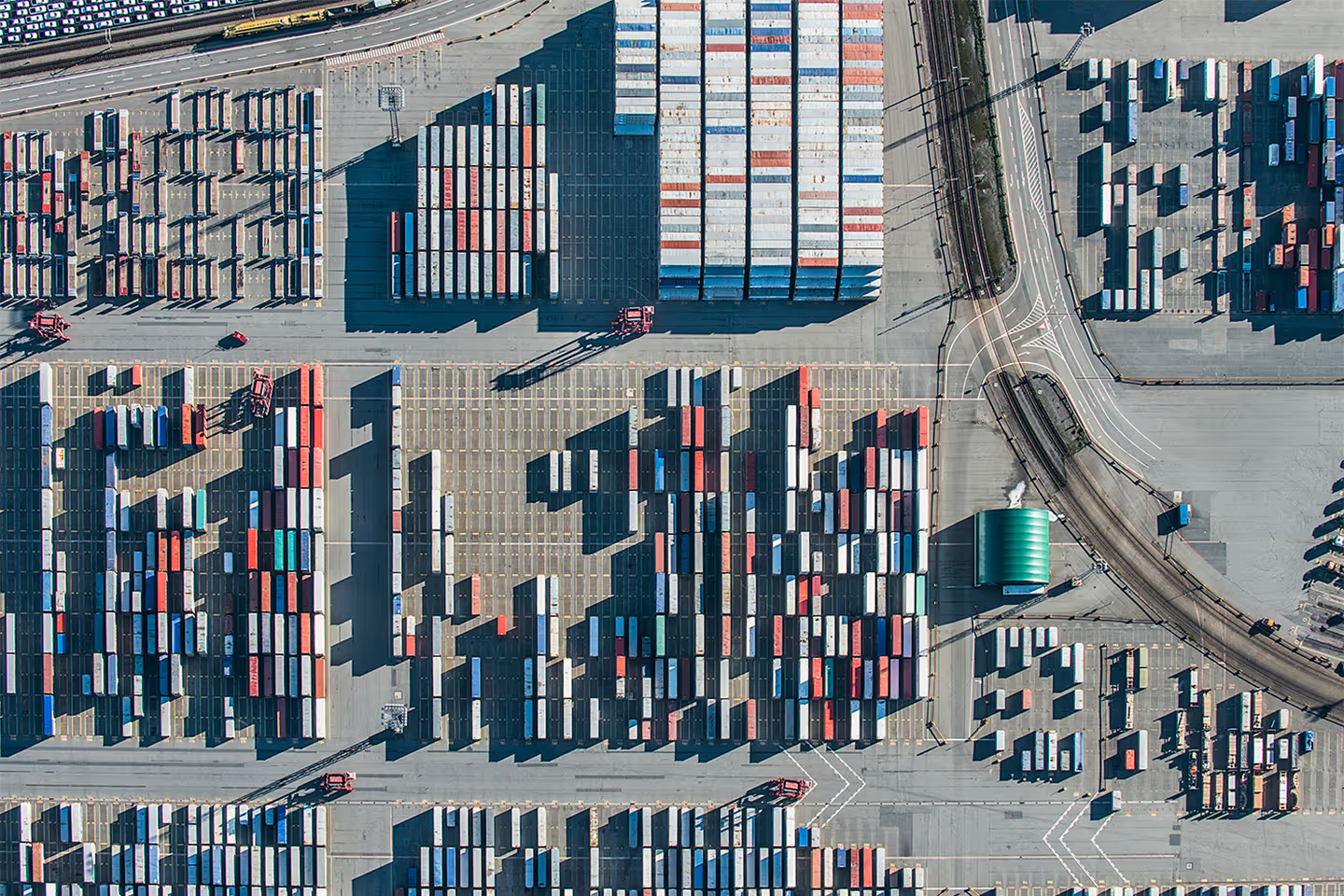
Data in motion
Artist Bernhard Lang used aerial photography to capture the enormity of the international shipping industry. Digital twins can track, simulate and anticipate the complexity of these vast fleets’ movements, helping to navigate the “what ifs” before they unfold.
but while this does pose a challenge for today’s implementation, it’s also a marker for the immense long-term potential of digital twins in logistics. Because the real growth story seems to be less the erection of hundreds of company-specific digital twin fortresses, but of all those digital twins communicating and cooperating. “We’re not there yet,” says Ralf Belusa, former chief digital officer of German logistics corporation Hapag-Lloyd, “but once the digital twins of the different players in the industry start interacting with each other, we’ll see quantum leaps in efficiency and reliability.”
This sounds like the reenactment of logistics’ biggest success story in the 20th century: the freight container. It also doesn’t make much sense as a stand-alone solution, but once it has reached a critical mass, its competitive advantages just wipe out all of the competition. While the first trip of a container ship (from Newark to Houston) started in April 1956, it took a few more years before the first container terminal was built, and a few more after that until a critical mass of ports was equipped with cranes for container handling, so that the era of global container shipping could take off. Since the early 1970s, the rest was scaling – of ships, of ports and of terminals.
The minimum value the global digital twin market is expected to reach by 2032, increasing at a projected annual growth rate of 30-40%.
Source: Maersk
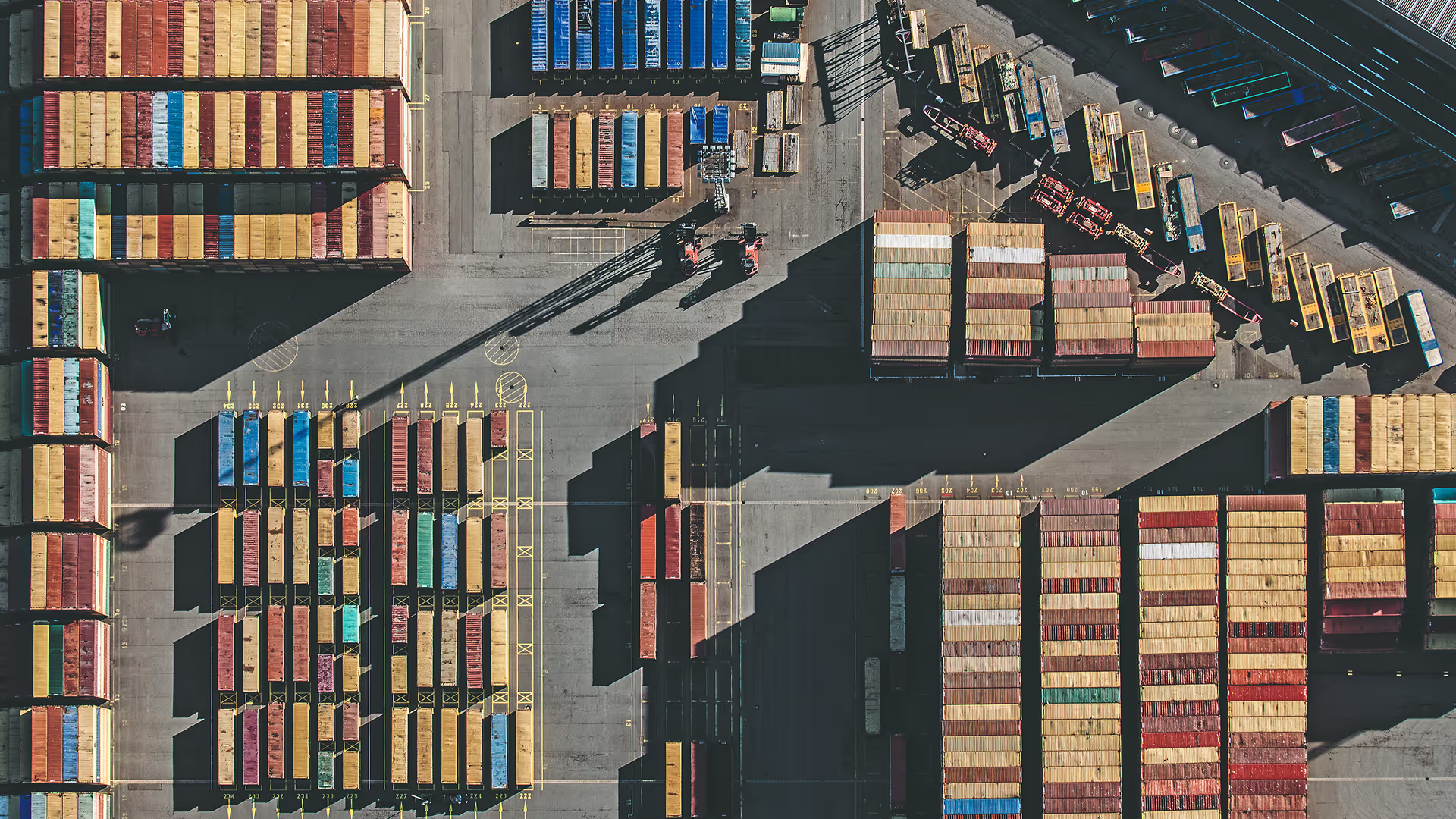
PARALLEL SYSTEMS
Lang’s photos reveal shipping harbors as networks of structures. Digital twins mirror this world in real time, running simulations across multiple interconnected supply chains and allowing operators to foresee disruptions.
Now digital twin technology is building up a similar critical mass and supply chain chaos is speeding up the transformation. Contingency planning for emergencies has been and will be the main driver for digital twin technology. This is where the huge investments in data processing and data storage pay off. And, let’s face it: Emergencies are no longer a volcano eruption here or a shut Suez Canal there – they have become part of the daily business. With tariffs changing almost daily (in one case even twice during one business day), with trade wars looming and with global economic coordination stuttering, you have a lot of unpredictable chaos to prepare for. And that’s exactly where the “what ifs” of a digital twin are needed.
Once they are in place, they can also help with the non-chaotic “what ifs” – the ones that “just” save money in daily business. In an interview on the company website, Ralf Struckmeier, vice president of Lufthansa Industry Solutions, gives the example of identifying the links in a real-world transport chain that are not time-critical: “If we can accurately estimate which trucks, ships, planes, etc. will be able to make it on time to a given time slot at the world’s major goods handling hubs – and which will not – we can significantly slow down many transport routes: The ‘race’ for slots will decrease, and with it fuel consumption.” In Struckmeier’s view, the “real optimization potential of the digital twin” lies not in emergencies, but in the daily routine of adapting the virtually mapped processes for higher efficiency.
Bots and bottlenecks
private investment in AI has accelerated sharply, underscoring the growing gap between US funding levels and those in Europe and China.
Adapted from the Technology toolkit in Think:Act Magazine 47, part of a three-part series offering data insights on geopolitics, technology and organizations.
Trying to predict how the logistics industry will change once digital twins have reached critical mass is a bit like predicting in the mid-1960s how freight containers might change the industry once they’ve become common practice. But in spite of all the loose ends and open horizons out there, experts are trying to grasp the far-reaching potentials. Like Dmitry Ivanov, professor and director of the Digital Supply Chain Lab at HRW Berlin. He predicts two consecutive developments for the industry. The first: “from simulations to decision-making support systems.” While the digital twin technology comes out of a simulation context with scenarios for specific “what if's in mind, “the availability of real-time data or increased data accuracy opens up more opportunities.” You don’t have to know your “what if” question in advance to work toward the answer, you just ask whatever “what if” comes up. This way, every decision-making process can be supported by the digital twin. In the end, the whole process of getting something not just from A to B, but from A to Z could be digitally organized and automatized – from the point of production to the point of consumption.
And in Ivanov’s next step, you don’t even have to ask the question. Digital twins “will create their own knowledge by the (self-)learning models, that even can take over some role in decision-making.” Ivanov sees the industry “on the way from data-driven organizations toward digitally organized management systems.” Something like self-driving trucks going to automatized ports, where they are loaded or unloaded according to self-deciding logistics management systems. Looks like we might be getting there – one digital twin at a time.
Takeaways


More from this edition







Stay ahead of the curve!
Sign up for our newsletter and let Think:Act bring you up to speed with what is happening today and guide you on what’s happening next.
